determine whether the following statements are true and give an explanation or counterexample. a. true…
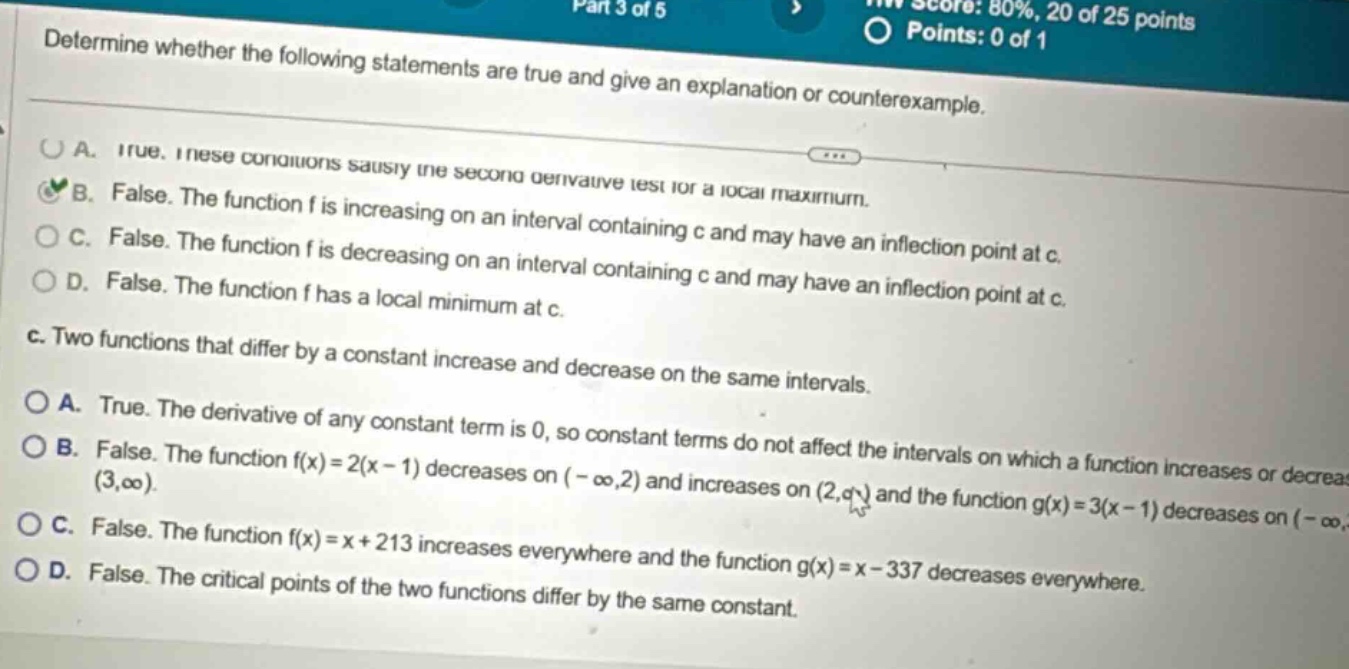
determine whether the following statements are true and give an explanation or counterexample. a. true. these conditions satisfy the second derivative test for a local maximum. b. false. the function f is increasing on an interval containing c and may have an inflection point at c. c. false. the function f is decreasing on an interval containing c and may have an inflection point at c. d. false. the function f has a local minimum at c. c. two functions that differ by a constant increase and decrease on the same intervals. a. true. the derivative of any constant term is 0, so constant terms do not affect the intervals on which a function increases or decreases. b. false. the function f(x)=2(x - 1) decreases on (-∞,2) and increases on (2,∞) and the function g(x)=3(x - 1) decreases on (-∞, (3,∞)). c. false. the function f(x)=x + 213 increases everywhere and the function g(x)=x - 337 decreases everywhere. d. false. the critical points of the two functions differ by the same constant.
Answer
Explanation:
Step1: Recall derivative - constant property
The derivative of a function (y = f(x)+C) (where (C) is a constant) is (y'=f'(x)) since (\frac{d}{dx}(C) = 0). The sign of the derivative (y') determines where the function is increasing ((y'>0)) or decreasing ((y'<0)). Since the derivative of a constant is 0, two functions that differ by a constant have the same derivative.
Step2: Analyze increasing - decreasing intervals
If two functions (f(x)) and (g(x)) such that (g(x)=f(x)+C), then (g'(x)=f'(x)). So, the intervals where (f'(x)>0) (where (f) is increasing) are the same as the intervals where (g'(x)>0) (where (g) is increasing), and the intervals where (f'(x)<0) (where (f) is decreasing) are the same as the intervals where (g'(x)<0) (where (g) is decreasing).
Answer:
A. True. The derivative of any constant term is 0, so constant terms do not affect the intervals on which a function increases or decreases.