determine whether the following statements are true and give an explanation or counterexample. b. false. the…
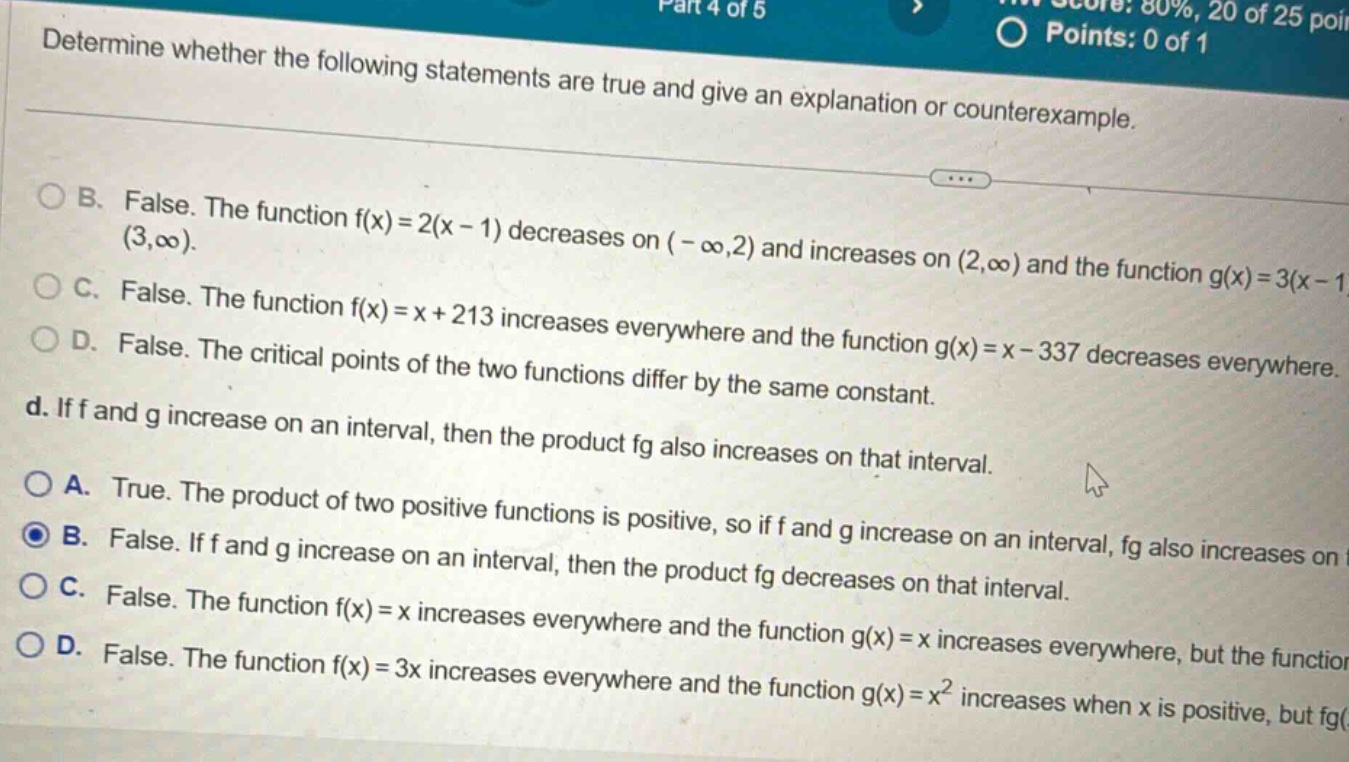
determine whether the following statements are true and give an explanation or counterexample. b. false. the function f(x)=2(x - 1) decreases on (-∞,2) and increases on (2,∞) and the function g(x)=3(x - 1) (3,∞). c. false. the function f(x)=x + 213 increases everywhere and the function g(x)=x - 337 decreases everywhere. d. false. the critical points of the two functions differ by the same constant. d. if f and g increase on an interval, then the product fg also increases on that interval. a. true. the product of two positive functions is positive, so if f and g increase on an interval, fg also increases on. b. false. if f and g increase on an interval, then the product fg decreases on that interval. c. false. the function f(x)=x increases everywhere and the function g(x)=x increases everywhere, but the function. d. false. the function f(x)=3x increases everywhere and the function g(x)=x² increases when x is positive, but fg(
Answer
Explanation:
Step1: Recall product - rule for derivatives
Let (y = f(x)g(x)). By the product - rule, (y'=f'(x)g(x)+f(x)g'(x)). Just because (f'(x)>0) and (g'(x)>0) on an interval does not mean (y'>0) on that interval.
Step2: Provide a counter - example
Let (f(x)=x) and (g(x)=x). Then (f'(x) = 1>0) and (g'(x)=1>0) for all (x\in R). But (y = f(x)g(x)=x^{2}), and (y' = 2x). The function (y=x^{2}) is decreasing on ((-\infty,0)) and increasing on ((0,\infty)). So, if (f) and (g) increase on an interval, the product (fg) does not necessarily increase on that interval.
Answer:
D. False. The function (f(x)=3x) increases everywhere and the function (g(x)=x^{2}) increases when (x) is positive, but (fg)