determine whether the following statements are true and give an explanation or counterexample. b. true. the…
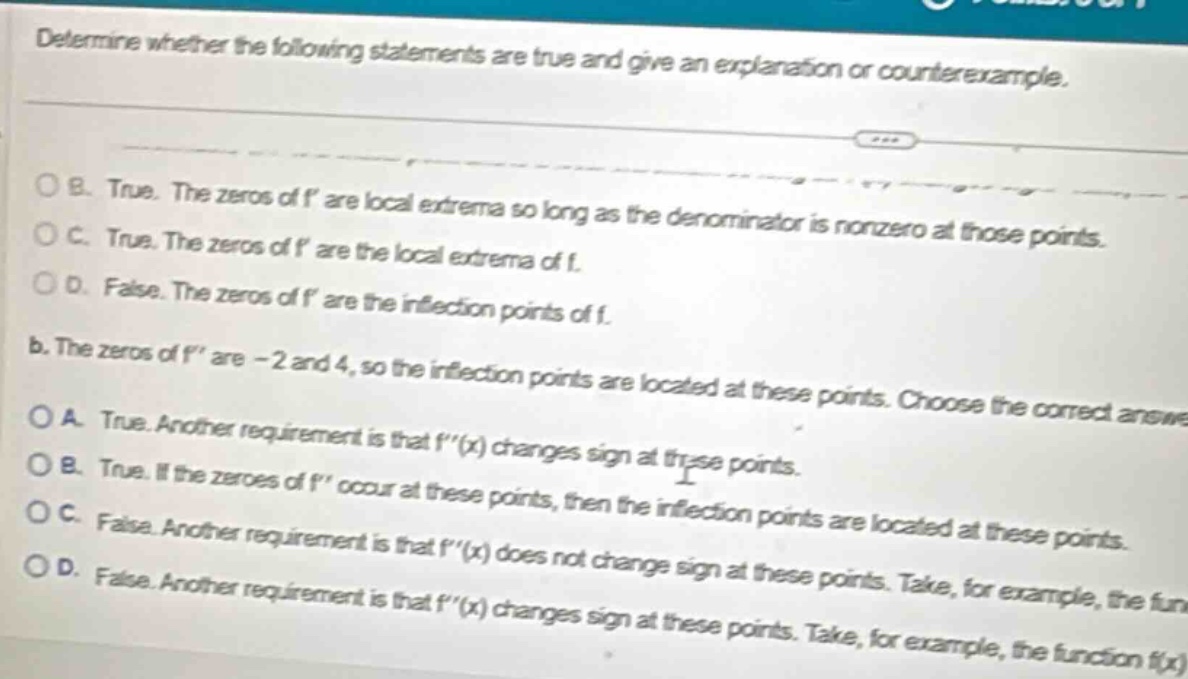
determine whether the following statements are true and give an explanation or counterexample. b. true. the zeros of f are local extrema so long as the denominator is nonzero at those points. c. true. the zeros of f are the local extrema of f. d. false. the zeros of f are the inflection points of f. b. the zeros of f are - 2 and 4, so the inflection points are located at these points. choose the correct answer. a. true. another requirement is that f(x) changes sign at these points. b. true. if the zeroes of f occur at these points, then the inflection points are located at these points. c. false. another requirement is that f(x) does not change sign at these points. d. false. another requirement is that f(x) changes sign at these points. take, for example, the function f(x)
Answer
Explanation:
Step1: Recall local - extrema and derivative relationship
The zeros of (f^{\prime}(x)) are critical points. A critical point (c) is a local extremum if (f^{\prime}(x)) changes sign at (x = c) and the function is continuous at (x=c). Just having (f^{\prime}(c)=0) is not enough to guarantee a local extremum, and the statement about the denominator is not relevant to the local - extrema condition for a single - variable function (y = f(x)). So the statement about zeros of (f^{\prime}) being local extrema is false.
Step2: Recall inflection - points and second - derivative relationship
An inflection point of a function (y = f(x)) occurs at a point (x = c) where (f^{\prime\prime}(c)=0) and (f^{\prime\prime}(x)) changes sign at (x = c). Just having (f^{\prime\prime}(c)=0) is not sufficient to say that (x = c) is an inflection point.
Answer:
a. False. The zeros of (f^{\prime}) are critical points, and for them to be local extrema, (f^{\prime}) must change sign at those points. b. False. Another requirement is that (f^{\prime\prime}(x)) changes sign at these points.