determine whether the following statements are true and give an explanation or counterexample. c. false…
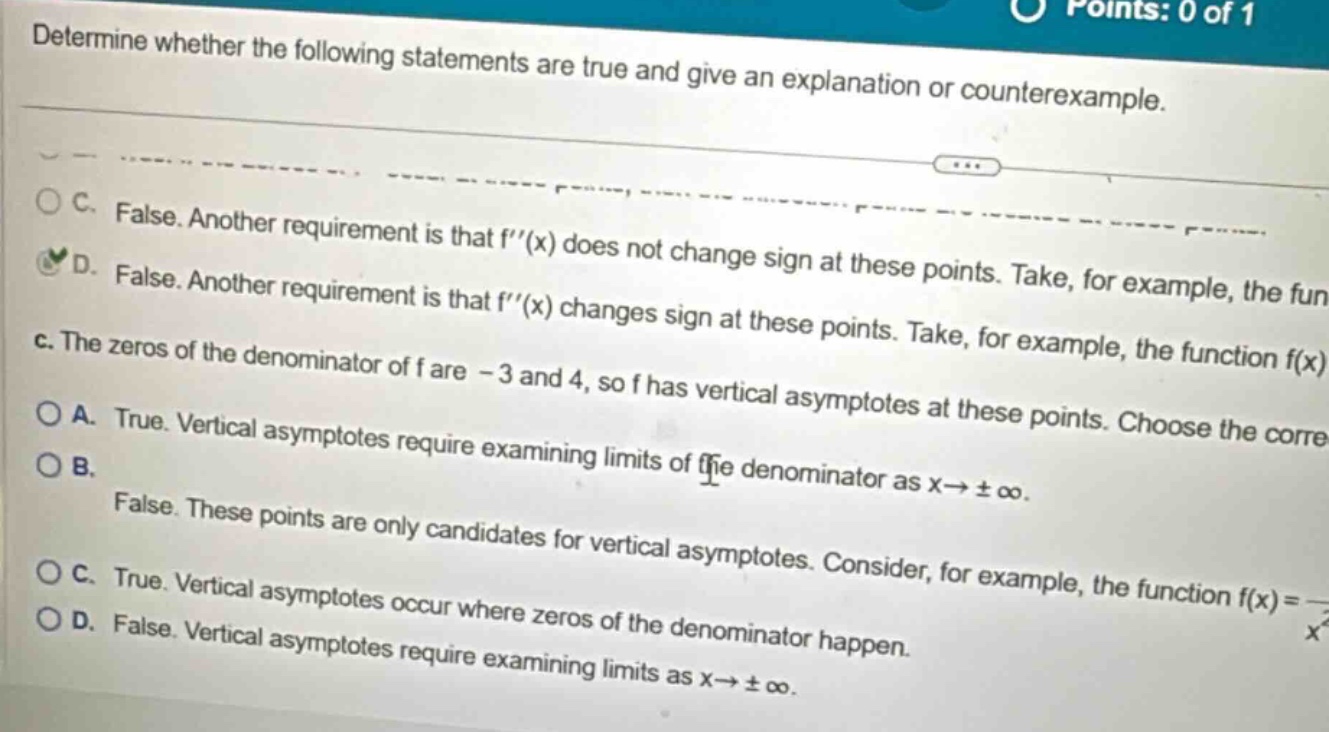
determine whether the following statements are true and give an explanation or counterexample. c. false. another requirement is that f′′(x) does not change sign at these points. d. false. another requirement is that f′′(x) changes sign at these points. take, for example, the function f(x) c. the zeros of the denominator of f are - 3 and 4, so f has vertical asymptotes at these points. choose the corre a. true. vertical asymptotes require examining limits of the denominator as x→±∞. b. false. these points are only candidates for vertical asymptotes. consider, for example, the function f(x)= c. true. vertical asymptotes occur where zeros of the denominator happen. d. false. vertical asymptotes require examining limits as x→±∞.
Answer
Explanation:
Step1: Recall vertical - asymptote definition
A function (y = f(x)=\frac{g(x)}{h(x)}) has a vertical asymptote at (x = a) if (\lim_{x\rightarrow a^{-}}f(x)=\pm\infty) or (\lim_{x\rightarrow a^{+}}f(x)=\pm\infty). Just because (h(a)=0) (where (a) is a zero of the denominator), (x = a) is only a candidate for a vertical asymptote. For example, if (g(a)=0) and the limit (\lim_{x\rightarrow a}f(x)) is finite (a removable - singularity case), then there is no vertical asymptote at (x = a).
Step2: Analyze the given statement
The statement says that since the zeros of the denominator of (f) are (- 3) and (4), (f) has vertical asymptotes at these points. This is false. The points (x=-3) and (x = 4) are only candidates for vertical asymptotes. We need to check the behavior of the function as (x) approaches these points. If the numerator is non - zero at these points, then there are vertical asymptotes, but if the numerator is also zero, we may have a removable singularity.
Answer:
B. False. These points are only candidates for vertical asymptotes.