determine whether the following statements are true and give an explanation or counterexample. d. false…
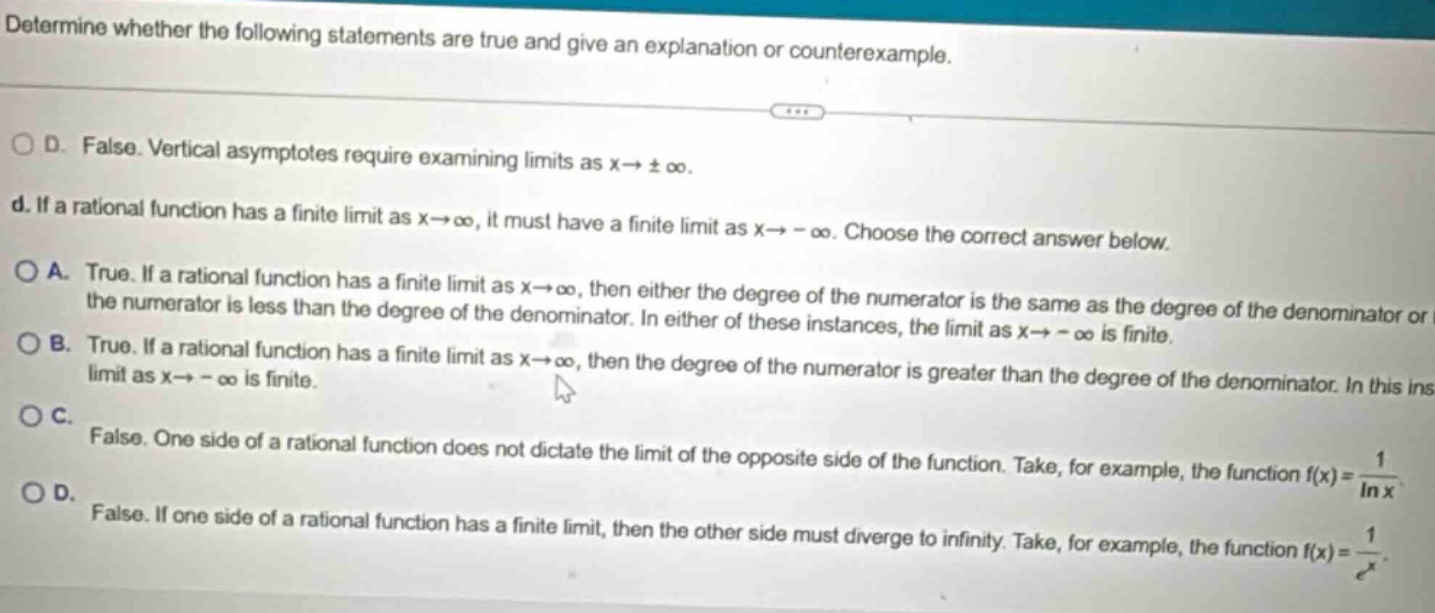
determine whether the following statements are true and give an explanation or counterexample. d. false. vertical asymptotes require examining limits as x→±∞. d. if a rational function has a finite limit as x→∞, it must have a finite limit as x→ - ∞. choose the correct answer below. a. true. if a rational function has a finite limit as x→∞, then either the degree of the numerator is the same as the degree of the denominator or the numerator is less than the degree of the denominator. in either of these instances, the limit as x→ - ∞ is finite. b. true. if a rational function has a finite limit as x→∞, then the degree of the numerator is greater than the degree of the denominator. in this ins c. false. one side of a rational function does not dictate the limit of the opposite side of the function. take, for example, the function f(x)=1/ln x. d. false. if one side of a rational function has a finite limit, then the other side must diverge to infinity. take, for example, the function f(x)=1/e^x.
Answer
Explanation:
Step1: Recall rational - function limit rules
For a rational function $f(x)=\frac{P(x)}{Q(x)}=\frac{a_nx^n + a_{n - 1}x^{n-1}+\cdots+a_0}{b_mx^m + b_{m - 1}x^{m-1}+\cdots+b_0}$, where $a_n\neq0$ and $b_m\neq0$. If $n < m$, $\lim_{x\rightarrow\pm\infty}f(x)=0$. If $n = m$, $\lim_{x\rightarrow\pm\infty}f(x)=\frac{a_n}{b_m}$.
Step2: Analyze the given statement
If a rational function has a finite limit as $x\rightarrow\infty$, then either the degree of the numerator $n$ is less than the degree of the denominator $m$ ($n<m$) or the degree of the numerator is equal to the degree of the denominator ($n = m$). In both cases, $\lim_{x\rightarrow-\infty}f(x)$ is also finite. When $n<m$, $\lim_{x\rightarrow-\infty}f(x)=0$ and when $n = m$, $\lim_{x\rightarrow-\infty}f(x)=\frac{a_n}{b_m}$, the same as $\lim_{x\rightarrow\infty}f(x)$.
Answer:
A. True. If a rational function has a finite limit as $x\rightarrow\infty$, then either the degree of the numerator is the same as the degree of the denominator or the numerator is less than the degree of the denominator. In either of these instances, the limit as $x\rightarrow-\infty$ is finite.