a. determine whether the mean value theorem applies to the function f(x)=2x^(1/9) on the interval -512,512…
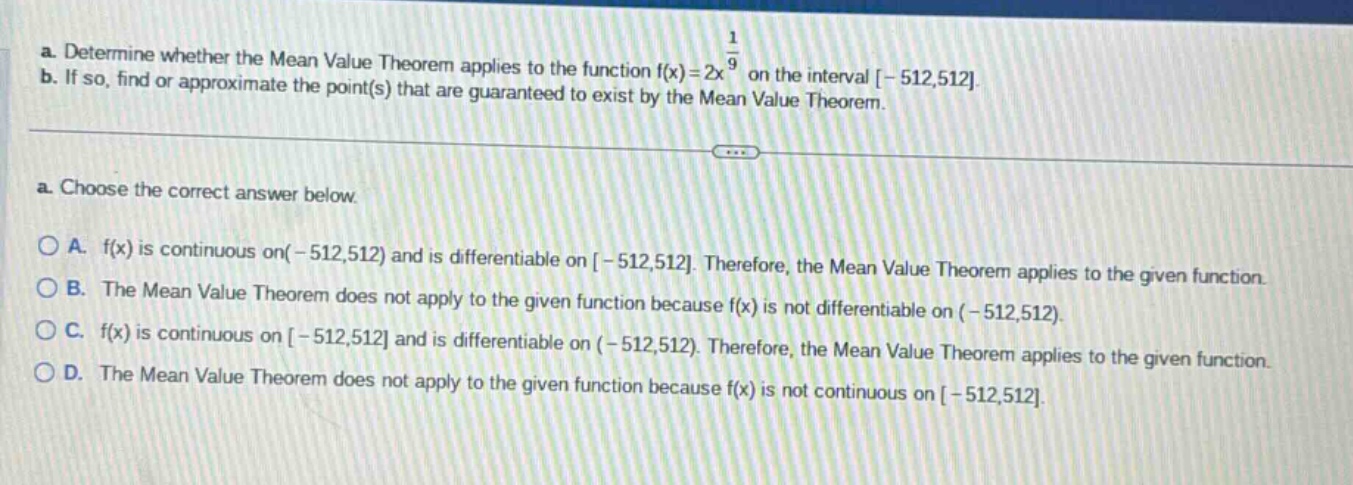
a. determine whether the mean value theorem applies to the function f(x)=2x^(1/9) on the interval -512,512. b. if so, find or approximate the point(s) that are guaranteed to exist by the mean value theorem. a. choose the correct answer below. a. f(x) is continuous on(-512,512) and is differentiable on -512,512. therefore, the mean value theorem applies to the given function. b. the mean value theorem does not apply to the given function because f(x) is not differentiable on (-512,512). c. f(x) is continuous on -512,512 and is differentiable on (-512,512). therefore, the mean value theorem applies to the given function. d. the mean value theorem does not apply to the given function because f(x) is not continuous on -512,512.
Answer
Explanation:
Step1: Check continuity
The function (y = f(x)=2x^{\frac{1}{9}}) is a power - function. The domain of (y = x^{\frac{1}{9}}=\sqrt[9]{x}) is all real numbers, so (f(x)) is continuous on the closed interval ([-512,512]).
Step2: Check differentiability
Differentiate (f(x)=2x^{\frac{1}{9}}) using the power rule (y = ax^{n}\Rightarrow y'=anx^{n - 1}). So (f'(x)=\frac{2}{9}x^{-\frac{8}{9}}=\frac{2}{9x^{\frac{8}{9}}}). The function (f(x)) is not differentiable at (x = 0) (since the derivative has a denominator of (x^{\frac{8}{9}}) and when (x = 0), the derivative is undefined). But the Mean - Value Theorem requires the function to be continuous on ([a,b]) and differentiable on ((a,b)). Here (a=-512), (b = 512) and (f(x)) is continuous on ([-512,512]) and differentiable on ((-512,512)) (the non - differentiable point (x = 0) is an interior point and the function is still differentiable on the open interval). The Mean Value Theorem states that if (y = f(x)) is continuous on ([a,b]) and differentiable on ((a,b)), then there exists at least one (c\in(a,b)) such that (f'(c)=\frac{f(b)-f(a)}{b - a}). First, find (f(-512)) and (f(512)): (f(-512)=2(-512)^{\frac{1}{9}}=2(-2)=-4) (f(512)=2(512)^{\frac{1}{9}}=2\times2 = 4) Then (\frac{f(512)-f(-512)}{512-(-512)}=\frac{4 - (-4)}{512 + 512}=\frac{8}{1024}=\frac{1}{128}) Set (f'(c)=\frac{1}{128}), so (\frac{2}{9c^{\frac{8}{9}}}=\frac{1}{128}) Cross - multiply gives (9c^{\frac{8}{9}}=2\times128 = 256) (c^{\frac{8}{9}}=\frac{256}{9}) (c=\pm(\frac{256}{9})^{\frac{9}{8}})
Answer:
a. C. (f(x)) is continuous on ([-512,512]) and is differentiable on ((-512,512)). Therefore, the Mean Value Theorem applies to the given function. b. (c=\pm(\frac{256}{9})^{\frac{9}{8}})