a. determine whether the mean value theorem applies to the function f(x)=6x^(1/9) on the interval -512,512…
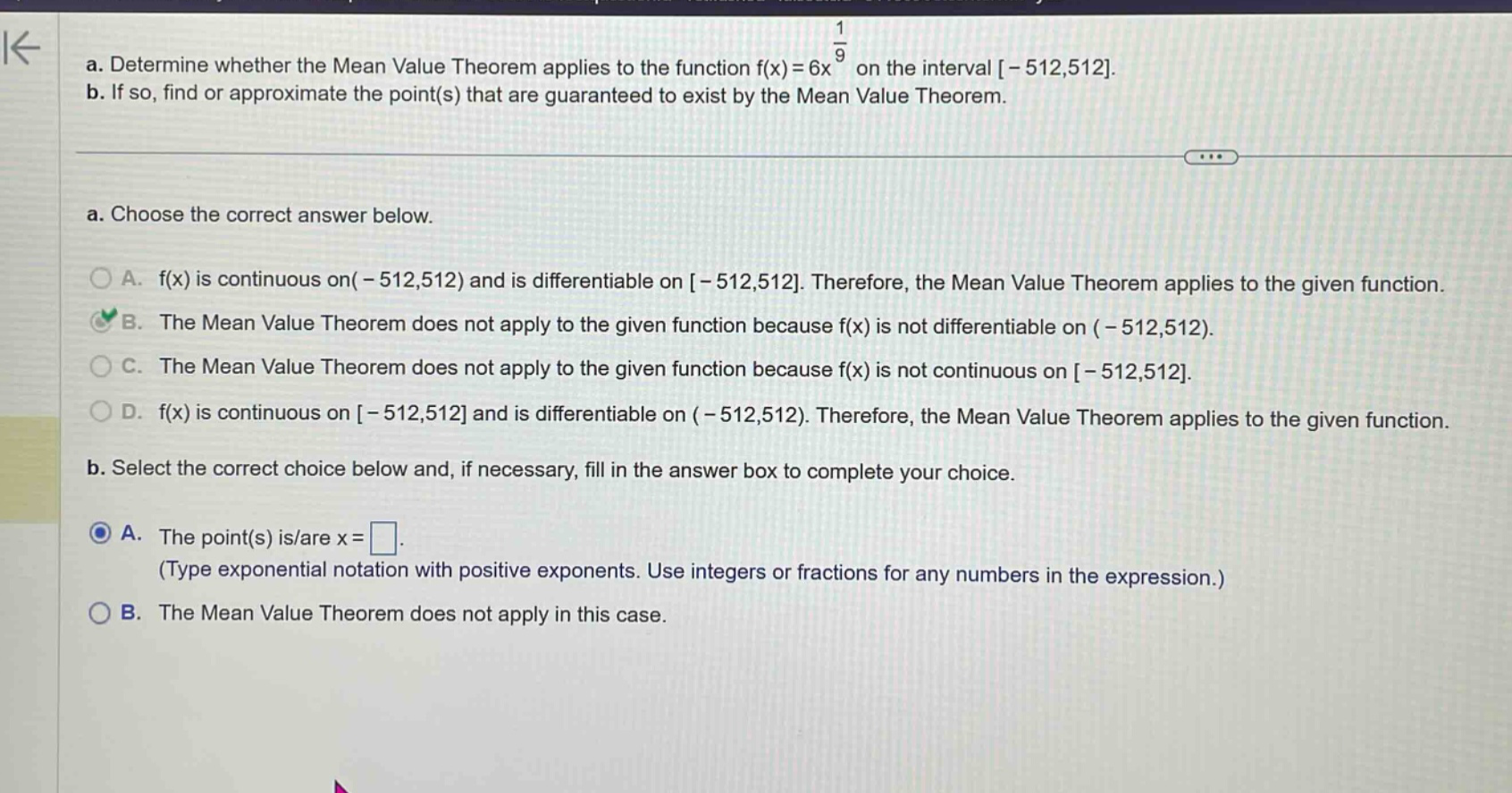
a. determine whether the mean value theorem applies to the function f(x)=6x^(1/9) on the interval -512,512. b. if so, find or approximate the point(s) that are guaranteed to exist by the mean value theorem. a. choose the correct answer below. a. f(x) is continuous on (-512,512) and is differentiable on -512,512. therefore, the mean value theorem applies to the given function. b. the mean value theorem does not apply to the given function because f(x) is not differentiable on (-512,512). c. the mean value theorem does not apply to the given function because f(x) is not continuous on -512,512. d. f(x) is continuous on -512,512 and is differentiable on (-512,512). therefore, the mean value theorem applies to the given function. b. select the correct choice below and, if necessary, fill in the answer box to complete your choice. a. the point(s) is/are x=□. (type exponential notation with positive exponents. use integers or fractions for any numbers in the expression.) b. the mean value theorem does not apply in this case.
Answer
Explanation:
Step1: Check continuity and differentiability
The function (y = f(x)=6x^{\frac{1}{9}}) has a derivative (y'=f'(x)=\frac{6}{9}x^{-\frac{8}{9}}=\frac{2}{3x^{\frac{8}{9}}}). The function is not differentiable at (x = 0\in(- 512,512)) since the derivative has a non - removable singularity at (x = 0). So the Mean - Value Theorem does not apply.
Step2: Analyze part b
Since the Mean - Value Theorem does not apply, we do not need to find the points guaranteed by the theorem.
Answer:
a. B. The Mean Value Theorem does not apply to the given function because (f(x)) is not differentiable on ((-512,512)). b. B. The Mean Value Theorem does not apply in this case.