a. determine whether the mean value theorem applies to the function f(x)=x + 1/x on the interval 3,7. b. if…
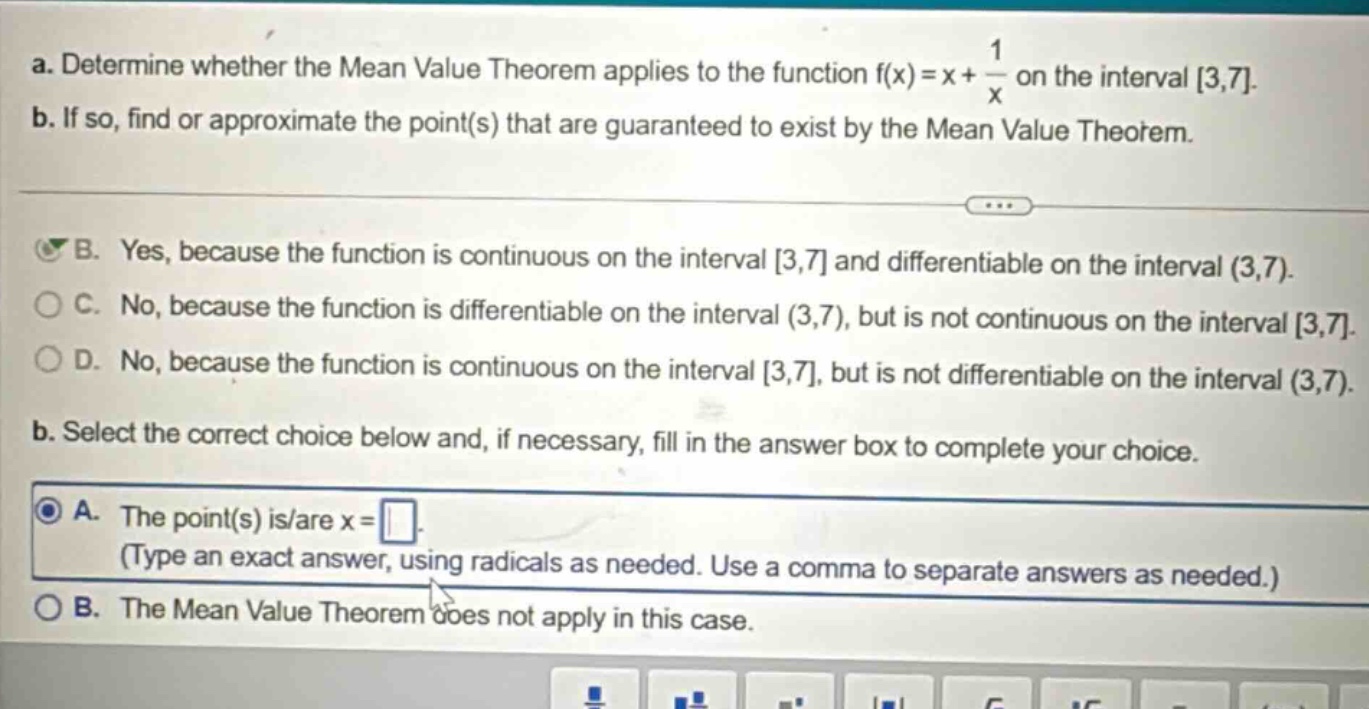
a. determine whether the mean value theorem applies to the function f(x)=x + 1/x on the interval 3,7. b. if so, find or approximate the point(s) that are guaranteed to exist by the mean value theorem. b. yes, because the function is continuous on the interval 3,7 and differentiable on the interval (3,7). c. no, because the function is differentiable on the interval (3,7), but is not continuous on the interval 3,7. d. no, because the function is continuous on the interval 3,7, but is not differentiable on the interval (3,7). b. select the correct choice below and, if necessary, fill in the answer box to complete your choice. a. the point(s) is/are x = . (type an exact answer, using radicals as needed. use a comma to separate answers as needed.) b. the mean value theorem does not apply in this case.
Answer
Explanation:
Step1: Recall Mean - Value Theorem conditions
The Mean - Value Theorem states that if (y = f(x)) is continuous on the closed interval ([a,b]) and differentiable on the open interval ((a,b)), then there exists at least one (c\in(a,b)) such that (f^{\prime}(c)=\frac{f(b)-f(a)}{b - a}). The function (f(x)=x+\frac{1}{x}) is a rational - type function. It is continuous on ([3,7]) and differentiable on ((3,7)) since (x = 0) is the only point of discontinuity and non - differentiability of (f(x)) and (0\notin[3,7]).
Step2: Calculate (f(a)) and (f(b))
Given (a = 3), (b = 7), (f(x)=x+\frac{1}{x}), then (f(3)=3+\frac{1}{3}=\frac{9 + 1}{3}=\frac{10}{3}), (f(7)=7+\frac{1}{7}=\frac{49+1}{7}=\frac{50}{7}).
Step3: Calculate (\frac{f(b)-f(a)}{b - a})
(\frac{f(7)-f(3)}{7 - 3}=\frac{\frac{50}{7}-\frac{10}{3}}{4}=\frac{\frac{150 - 70}{21}}{4}=\frac{\frac{80}{21}}{4}=\frac{20}{21}).
Step4: Find the derivative of (f(x))
(f^{\prime}(x)=1-\frac{1}{x^{2}}).
Step5: Set (f^{\prime}(c)) equal to (\frac{f(b)-f(a)}{b - a}) and solve for (c)
Set (1-\frac{1}{x^{2}}=\frac{20}{21}). Then (\frac{1}{x^{2}}=1-\frac{20}{21}=\frac{1}{21}), so (x^{2}=21). Since (x\in(3,7)), (x=\sqrt{21}).
Answer:
A. The point(s) is/are (x = \sqrt{21})