a. determine whether the mean value theorem applies to the function f(x)=x + 1/x on the interval -4,-3. b…
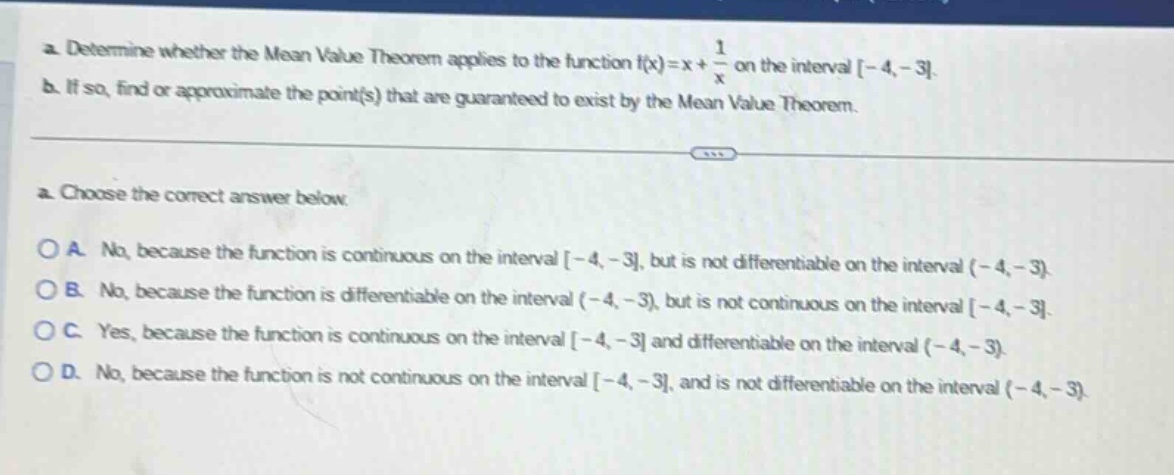
a. determine whether the mean value theorem applies to the function f(x)=x + 1/x on the interval -4,-3. b. if so, find or approximate the point(s) that are guaranteed to exist by the mean value theorem. a. choose the correct answer below. oa. no, because the function is continuous on the interval -4,-3, but is not differentiable on the interval (-4,-3). ob. no, because the function is differentiable on the interval (-4,-3), but is not continuous on the interval -4,-3. oc. yes, because the function is continuous on the interval -4,-3 and differentiable on the interval (-4,-3). od. no, because the function is not continuous on the interval -4,-3, and is not differentiable on the interval (-4,-3).
Answer
Explanation:
Step1: Check continuity
The function $f(x)=x + \frac{1}{x}$ is a sum of a polynomial $y = x$ and a rational - function $y=\frac{1}{x}$. The rational function $y=\frac{1}{x}$ is undefined at $x = 0$, but the interval $[-4,-3]$ does not contain $x = 0$. A polynomial is continuous everywhere and a rational function $\frac{1}{x}$ is continuous on its domain. So, $f(x)$ is continuous on $[-4,-3]$.
Step2: Check differentiability
Differentiate $f(x)$ using the sum - rule and the power - rule. The derivative of $y=x$ is $y^\prime=1$, and the derivative of $y = \frac{1}{x}=x^{-1}$ is $y^\prime=-x^{-2}=-\frac{1}{x^{2}}$. So, $f^\prime(x)=1-\frac{1}{x^{2}}$. This derivative exists for all $x\neq0$. Since $x\in(-4,-3)$ (the open - interval corresponding to $[-4,-3]$) and $0\notin(-4,-3)$, the function $f(x)$ is differentiable on $(-4,-3)$.
Step3: Apply Mean - Value Theorem
The Mean - Value Theorem states that if $y = f(x)$ is continuous on $[a,b]$ and differentiable on $(a,b)$, then there exists at least one $c\in(a,b)$ such that $f^\prime(c)=\frac{f(b)-f(a)}{b - a}$. Here, $a=-4$, $b = - 3$, $f(a)=-4-\frac{1}{4}=-\frac{16 + 1}{4}=-\frac{17}{4}$, $f(b)=-3-\frac{1}{3}=-\frac{9 + 1}{3}=-\frac{10}{3}$. Then $\frac{f(b)-f(a)}{b - a}=\frac{-\frac{10}{3}+\frac{17}{4}}{-3 + 4}=\frac{-\frac{40}{12}+\frac{51}{12}}{1}=\frac{11}{12}$. Set $f^\prime(c)=1-\frac{1}{c^{2}}=\frac{11}{12}$. Solve for $c$: [ \begin{align*} 1-\frac{1}{c^{2}}&=\frac{11}{12}\ -\frac{1}{c^{2}}&=\frac{11}{12}-1\ -\frac{1}{c^{2}}&=\frac{11 - 12}{12}\ -\frac{1}{c^{2}}&=-\frac{1}{12}\ c^{2}&=12\ c&=\pm2\sqrt{3} \end{align*} ] Since $c\in(-4,-3)$, $c=-2\sqrt{3}\approx - 3.46$.
Answer:
a. C. Yes, because the function is continuous on the interval $[-4,-3]$ and differentiable on the interval $(-4,-3)$. b. $c=-2\sqrt{3}\approx - 3.46$