a. determine whether the mean value theorem applies to the function f(x)= - 4 + x² on the interval -1,2. b…
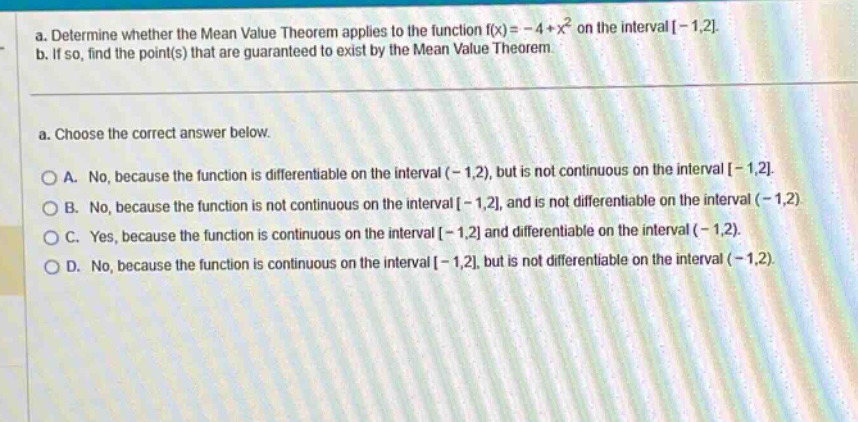
a. determine whether the mean value theorem applies to the function f(x)= - 4 + x² on the interval -1,2. b. if so, find the point(s) that are guaranteed to exist by the mean value theorem. a. choose the correct answer below. a. no, because the function is differentiable on the interval (-1,2), but is not continuous on the interval -1,2. b. no, because the function is not continuous on the interval -1,2, and is not differentiable on the interval (-1,2) c. yes, because the function is continuous on the interval -1,2 and differentiable on the interval (-1,2). d. no, because the function is continuous on the interval -1,2, but is not differentiable on the interval (-1,2).
Answer
Explanation:
Step1: Check continuity
The function $f(x)=-4 + x^{2}$ is a polynomial. Polynomials are continuous everywhere, so it is continuous on $[-1,2]$.
Step2: Check differentiability
The derivative of $f(x)$ is $f'(x)=2x$. Since the derivative exists for all real - numbers, the function is differentiable on $(-1,2)$.
Step3: Apply Mean - Value Theorem
The Mean - Value Theorem states that if $y = f(x)$ is continuous on the closed interval $[a,b]$ and differentiable on the open interval $(a,b)$, then there exists at least one number $c\in(a,b)$ such that $f'(c)=\frac{f(b)-f(a)}{b - a}$. Here, $a=-1$, $b = 2$, $f(-1)=-4+(-1)^{2}=-3$, $f(2)=-4 + 2^{2}=0$. Then $\frac{f(2)-f(-1)}{2-(-1)}=\frac{0-(-3)}{3}=1$.
Step4: Find the value of $c$
Set $f'(c)=1$. Since $f'(x)=2x$, then $2c = 1$, so $c=\frac{1}{2}$.
Answer:
a. C. Yes, because the function is continuous on the interval $[-1,2]$ and differentiable on the interval $(-1,2)$. b. $c=\frac{1}{2}$