determine whether rolles theorem applies to the given function on the given interval. if so, find the…
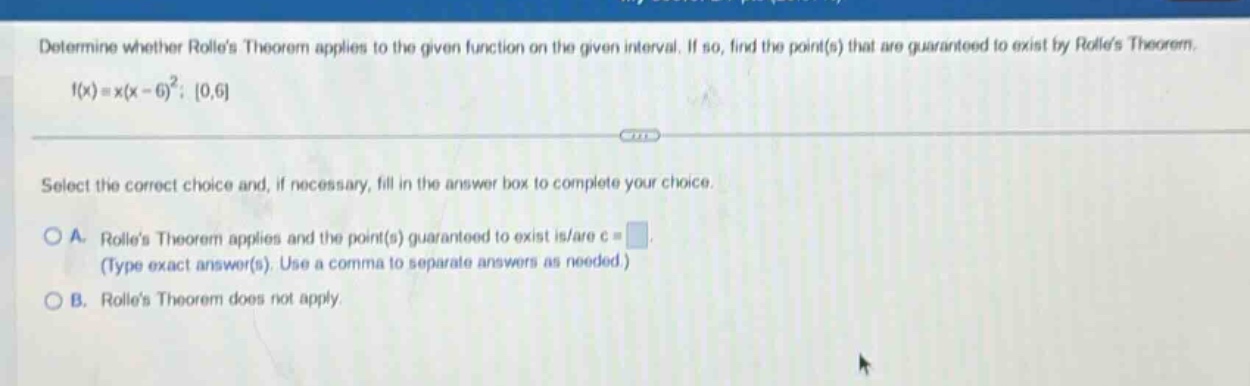
determine whether rolles theorem applies to the given function on the given interval. if so, find the point(s) that are guaranteed to exist by rolles theorem. f(x)=x(x - 6)^2; 0,6 select the correct choice and, if necessary, fill in the answer box to complete your choice. a. rolles theorem applies and the point(s) guaranteed to exist is/are c = (type exact answer(s). use a comma to separate answers as needed.) b. rolles theorem does not apply.
Answer
Explanation:
Step1: Check continuity
The function $f(x)=x(x - 6)^2=x(x^{2}-12x + 36)=x^{3}-12x^{2}+36x$ is a polynomial. Polynomials are continuous everywhere, so $f(x)$ is continuous on $[0,6]$.
Step2: Check differentiability
The derivative of $f(x)$ using the product - rule or by expanding first. If we expand $f(x)=x^{3}-12x^{2}+36x$, then $f^\prime(x)=3x^{2}-24x + 36$. Polynomials are differentiable everywhere, so $f(x)$ is differentiable on $(0,6)$.
Step3: Check $f(0)$ and $f(6)$
$f(0)=0\times(0 - 6)^2=0$ and $f(6)=6\times(6 - 6)^2=0$. Since $f(x)$ is continuous on $[0,6]$, differentiable on $(0,6)$ and $f(0)=f(6)$, Rolle's Theorem applies.
Step4: Find $c$
Set $f^\prime(c)=0$. So $3c^{2}-24c + 36 = 0$. Divide through by 3: $c^{2}-8c + 12=0$. Factor the quadratic equation: $(c - 2)(c - 6)=0$. Solving for $c$ gives $c = 2$ or $c=6$. But $c\in(0,6)$, so $c = 2$.
Answer:
A. Rolle's Theorem applies and the point(s) guaranteed to exist is/are $c = 2$