determine whether the series ∑(3k + k²)/8 converges or diverges. options: diverges, converges, cannot be…
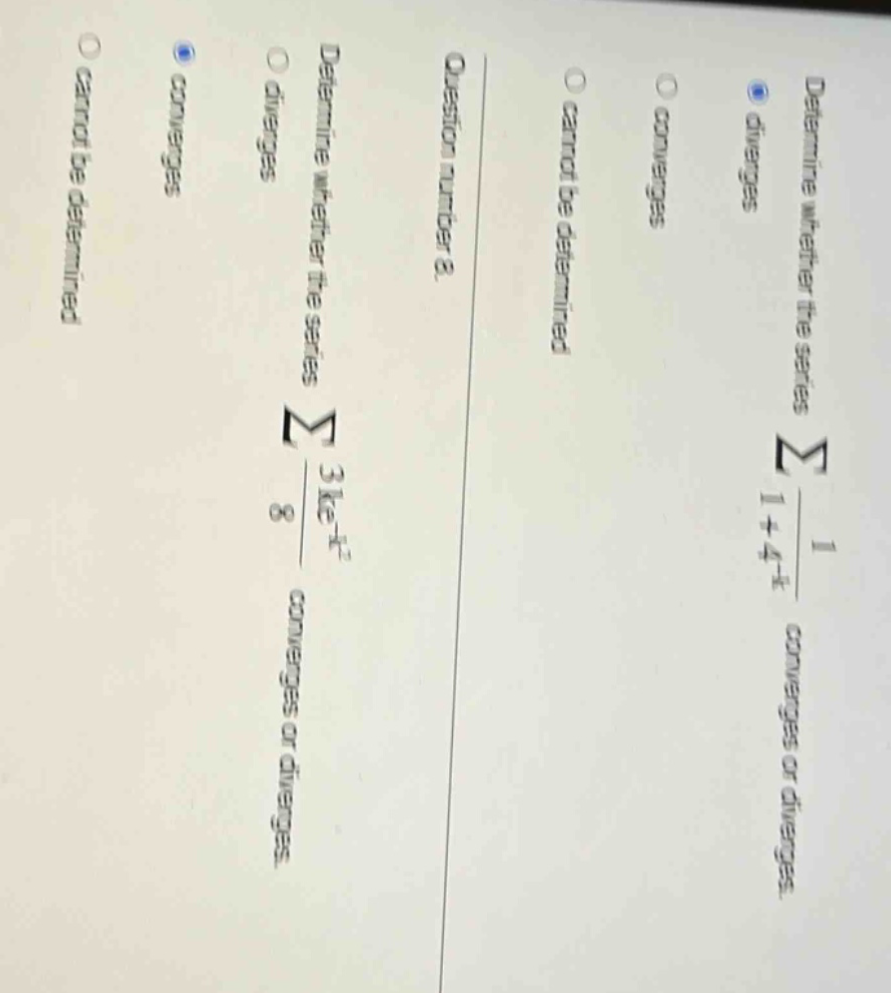
determine whether the series ∑(3k + k²)/8 converges or diverges. options: diverges, converges, cannot be determined. determine whether the series ∑(1/(1 + 4^k)) converges or diverges. options: diverges, converges, cannot be determined. question number 8.
Answer
Explanation:
Step1: Analyze the first - series $\sum_{k = 1}^{\infty}\frac{3k}{8 + k^{2}}$
Use the Limit Comparison Test. Compare with the series $\sum_{k=1}^{\infty}\frac{1}{k}$. Calculate the limit $\lim_{k\rightarrow\infty}\frac{\frac{3k}{8 + k^{2}}}{\frac{1}{k}}=\lim_{k\rightarrow\infty}\frac{3k^{2}}{8 + k^{2}}$.
Step2: Evaluate the limit
Divide both the numerator and denominator by $k^{2}$: $\lim_{k\rightarrow\infty}\frac{3k^{2}/k^{2}}{(8 + k^{2})/k^{2}}=\lim_{k\rightarrow\infty}\frac{3}{\frac{8}{k^{2}}+1}=3$. Since $\sum_{k = 1}^{\infty}\frac{1}{k}$ is a harmonic series (divergent) and the limit is a positive - finite number ($L = 3>0$), the series $\sum_{k = 1}^{\infty}\frac{3k}{8 + k^{2}}$ diverges.
Step3: Analyze the second - series $\sum_{k = 1}^{\infty}\frac{1}{1 + 4k}$
Use the Limit Comparison Test. Compare with the series $\sum_{k=1}^{\infty}\frac{1}{k}$. Calculate the limit $\lim_{k\rightarrow\infty}\frac{\frac{1}{1 + 4k}}{\frac{1}{k}}=\lim_{k\rightarrow\infty}\frac{k}{1 + 4k}$.
Step4: Evaluate the limit
Divide both the numerator and denominator by $k$: $\lim_{k\rightarrow\infty}\frac{k/k}{(1 + 4k)/k}=\lim_{k\rightarrow\infty}\frac{1}{\frac{1}{k}+4}=\frac{1}{4}$. Since $\sum_{k = 1}^{\infty}\frac{1}{k}$ is a harmonic series (divergent) and the limit is a positive - finite number ($L=\frac{1}{4}>0$), the series $\sum_{k = 1}^{\infty}\frac{1}{1 + 4k}$ diverges.
Answer:
The first series $\sum_{k = 1}^{\infty}\frac{3k}{8 + k^{2}}$ diverges; the second series $\sum_{k = 1}^{\infty}\frac{1}{1 + 4k}$ diverges.