determining a horizontal shift\nhow will the input of f(x + 11) affect the graph of f(x)=x? explain.\nthe…
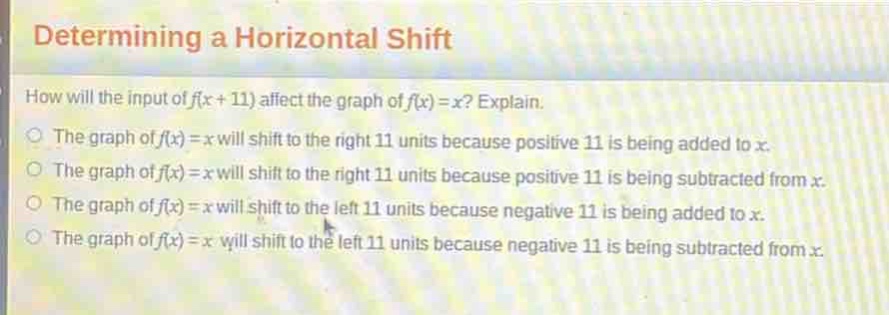
determining a horizontal shift\nhow will the input of f(x + 11) affect the graph of f(x)=x? explain.\nthe graph of f(x)=x will shift to the right 11 units because positive 11 is being added to x.\nthe graph of f(x)=x will shift to the right 11 units because positive 11 is being subtracted from x.\nthe graph of f(x)=x will shift to the left 11 units because negative 11 is being added to x.\nthe graph of f(x)=x will shift to the left 11 units because negative 11 is being subtracted from x.
Answer
Explanation:
Step1: Recall horizontal - shift rule
For a function $y = f(x)$, the graph of $y=f(x + h)$ is a horizontal shift of the graph of $y = f(x)$. If $h>0$, the graph shifts to the left by $h$ units; if $h < 0$, the graph shifts to the right by $|h|$ units.
Step2: Analyze the given function
In the function $f(x+11)$, we have $h = 11>0$. According to the rule, when we have $y=f(x + 11)$ compared to $y = f(x)$, the graph of $y=f(x)$ will shift to the left by 11 units. We can think of it in terms of the $x$ - values. To get the same $y$ - value as in $y = f(x)$ for $y=f(x + 11)$, we need to use an $x$ - value that is 11 units less (i.e., we are effectively subtracting 11 from the $x$ - value that would give the same output in $f(x)$).
Answer:
The graph of $f(x)=x$ will shift to the left 11 units because negative 11 is being subtracted from $x$.