determining the interval where the function is increasing\nusing only the values given in the table for the…
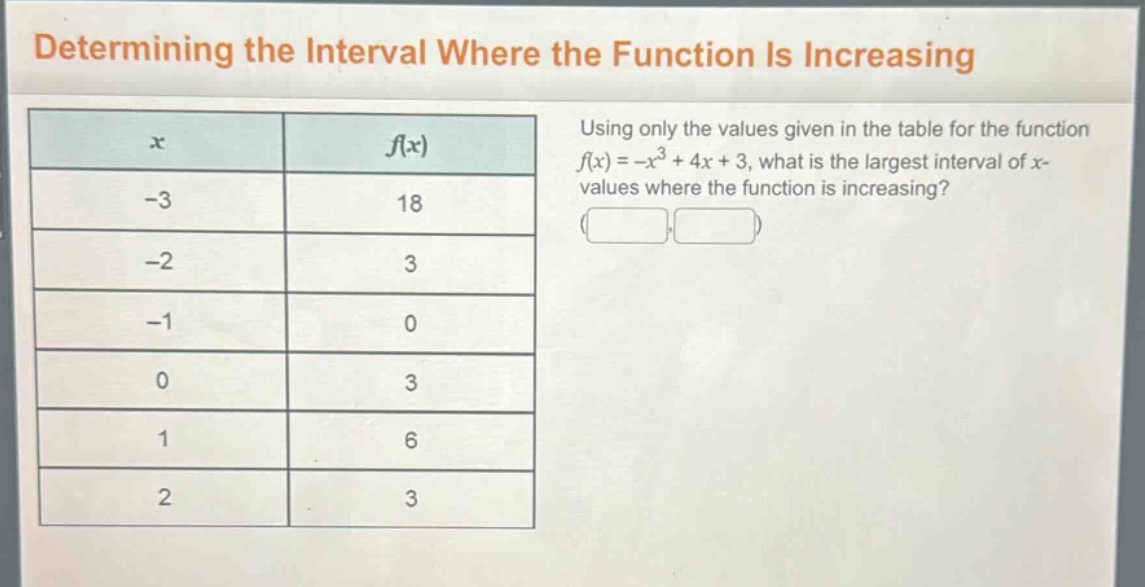
determining the interval where the function is increasing\nusing only the values given in the table for the function (f(x)=-x^{3}+4x + 3), what is the largest interval of (x -)values where the function is increasing?\n| (x) | (f(x)) |\n| ---- | ---- |\n| -3 | 18 |\n| -2 | 3 |\n| -1 | 0 |\n| 0 | 3 |\n| 1 | 6 |\n| 2 | 3 |
Answer
Explanation:
Step1: Check function values
We observe the change of $f(x)$ as $x$ increases. When $x$ goes from -3 to -2, $f(-3)=18$ and $f(-2) = 3$, function is decreasing. When $x$ goes from -2 to -1, $f(-2)=3$ and $f(-1)=0$, function is decreasing. When $x$ goes from -1 to 0, $f(-1) = 0$ and $f(0)=3$, function is increasing. When $x$ goes from 0 to 1, $f(0)=3$ and $f(1)=6$, function is increasing. When $x$ goes from 1 to 2, $f(1)=6$ and $f(2)=3$, function is decreasing.
Step2: Determine the largest increasing - interval
The increasing intervals are $(-1,0)$ and $(0,1)$. Combining them, the largest interval where the function is increasing using the table - values is $(-1,1)$.
Answer:
$(-1,1)$