6. if f is differentiable at x = a, which of the following could be false? (a) f is continuous at x = a. (b)…
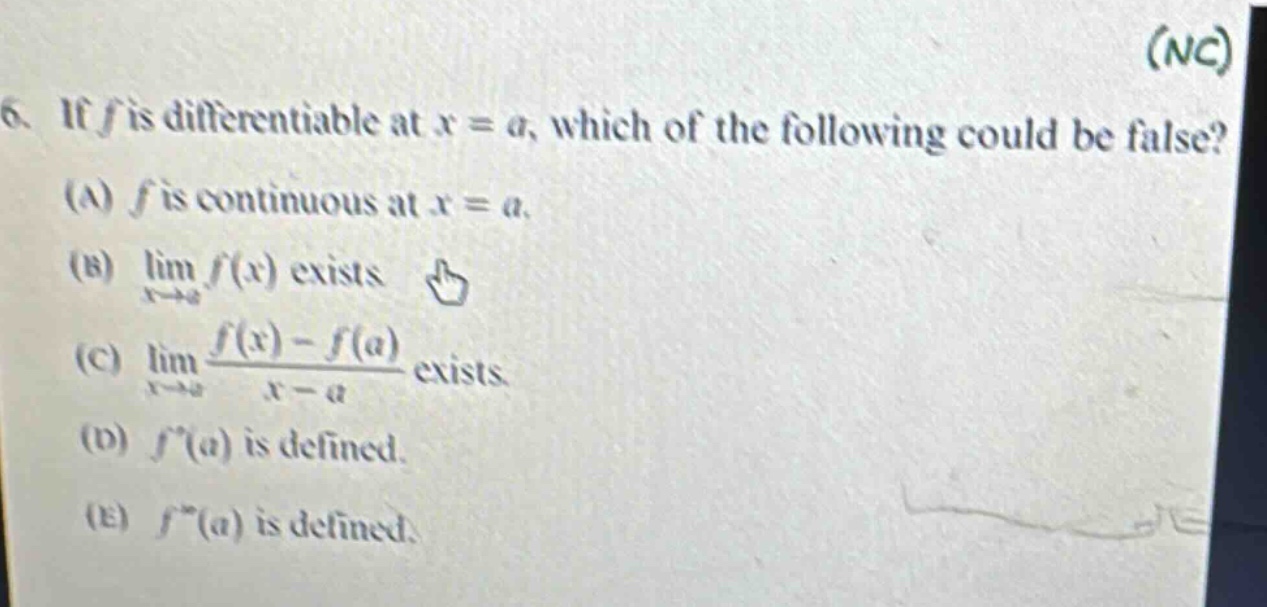
6. if f is differentiable at x = a, which of the following could be false? (a) f is continuous at x = a. (b) lim x→a f(x) exists (c) lim x→a (f(x)-f(a))/(x - a) exists. (d) f(a) is defined. (e) f(a) is defined.
Answer
Explanation:
Step1: Recall differentiability - continuity relationship
If a function $f(x)$ is differentiable at $x = a$, then it is continuous at $x=a$. So option (A) is true.
Step2: Recall limit existence for continuous functions
If a function is continuous at $x = a$, then $\lim_{x\rightarrow a}f(x)$ exists. So option (B) is true.
Step3: Recall the definition of the derivative
The derivative of a function $f(x)$ at $x = a$ is defined as $f^{\prime}(a)=\lim_{x\rightarrow a}\frac{f(x)-f(a)}{x - a}$. If $f$ is differentiable at $x = a$, this limit exists. So option (C) is true.
Step4: Recall the derivative notation
If $f$ is differentiable at $x = a$, then $f^{\prime}(a)$ is defined. So option (D) is true.
Step5: Analyze the second - derivative
Just because a function $f$ is differentiable at $x = a$ (i.e., $f^{\prime}(a)$ exists), it does not mean that the second - derivative $f^{\prime\prime}(a)$ exists. For example, $y = x^{\frac{3}{2}}$ is differentiable at $x = 0$ but its second - derivative does not exist at $x = 0$. So option (E) could be false.
Answer:
E. $f^{\prime\prime}(a)$ is defined.