the differentiable function r is increasing, and the graph of r is concave down. values of r(t) at selected…
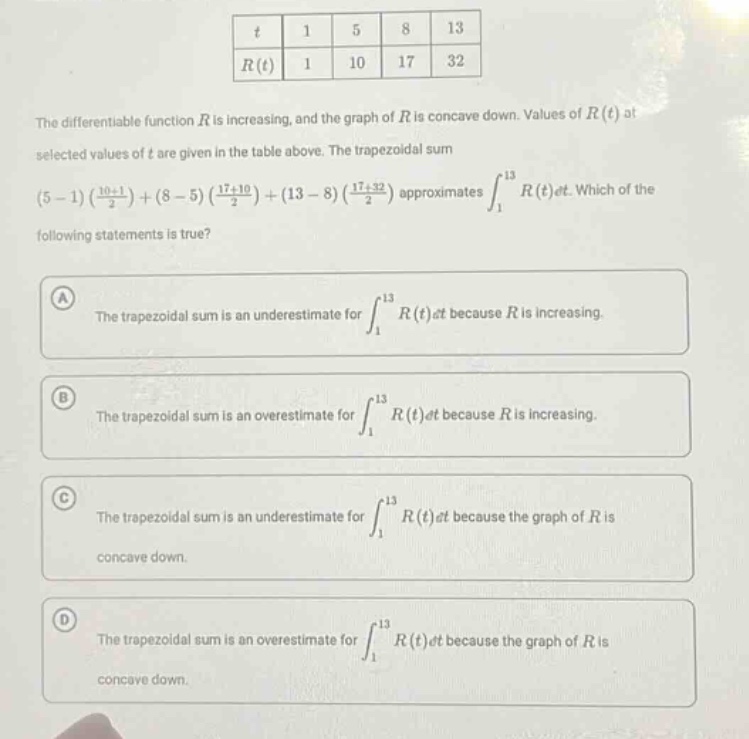
the differentiable function r is increasing, and the graph of r is concave down. values of r(t) at selected values of t are given in the table above. the trapezoidal sum (5 - 1)(10 + 1/2)+(8 - 5)(17 + 10/2)+(13 - 8)(17 + 32/2) approximates ∫1^13 r(t)dt. which of the following statements is true? a the trapezoidal sum is an underestimate for ∫1^13 r(t)dt because r is increasing. b the trapezoidal sum is an overestimate for ∫1^13 r(t)dt because r is increasing. c the trapezoidal sum is an underestimate for ∫1^13 r(t)dt because the graph of r is concave down. d the trapezoidal sum is an overestimate for ∫1^13 r(t)dt because the graph of r is concave down.
Answer
Explanation:
Step1: Recall trapezoidal - sum property
For a function (y = f(x)) on ([a,b]), the trapezoidal sum (T_n=\sum_{i = 1}^{n - 1}\frac{\Delta x_i}{2}(f(x_i)+f(x_{i + 1}))), where (\Delta x_i=x_{i + 1}-x_i).
Step2: Analyze concavity and trapezoidal - sum relationship
If the graph of a function (y = f(x)) is concave - down on an interval ([a,b]), then the trapezoids used in the trapezoidal sum lie below the graph of the function.
Step3: Determine the nature of the trapezoidal sum
Since the graph of (R(t)) is concave down on the interval ([1,13]), the trapezoidal sum (\sum_{i}\frac{\Delta t_i}{2}(R(t_i)+R(t_{i + 1}))) is an underestimate of (\int_{1}^{13}R(t)dt). The increasing nature of the function does not directly determine whether the trapezoidal sum is an over - estimate or under - estimate. The key factor here is the concavity.
Answer:
C. The trapezoidal sum is an underestimate for (\int_{1}^{13}R(t)dt) because the graph of (R) is concave down.