the differentiable function r is increasing, and the graph of r is concave down. values of r(t) at selected…
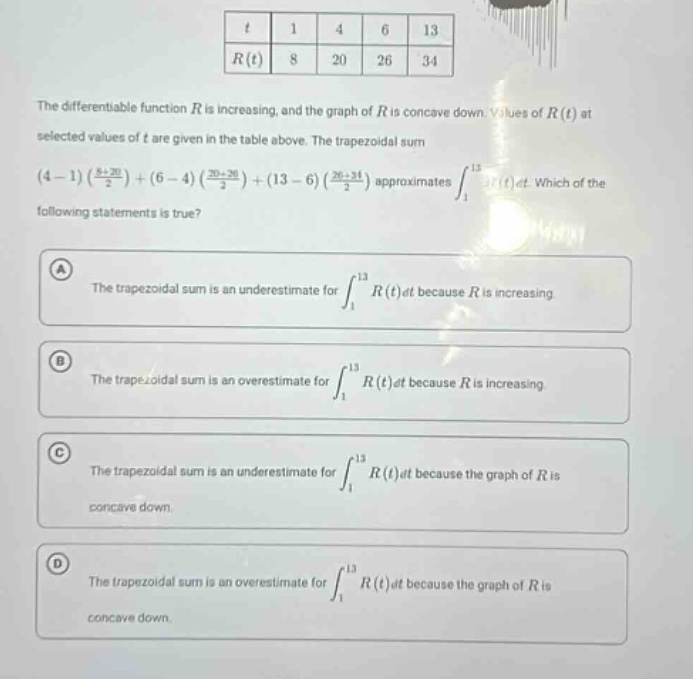
the differentiable function r is increasing, and the graph of r is concave down. values of r(t) at selected values of t are given in the table above. the trapezoidal sum (4 - 1)(8 + 20)/2+(6 - 4)(20 + 26)/2+(13 - 6)(26 + 34)/2 approximates ∫₁¹³r(t)dt. which of the following statements is true? a the trapezoidal sum is an underestimate for ∫₁¹³r(t)dt because r is increasing. b the trapezoidal sum is an overestimate for ∫₁¹³r(t)dt because r is increasing. c the trapezoidal sum is an underestimate for ∫₁¹³r(t)dt because the graph of r is concave down. d the trapezoidal sum is an overestimate for ∫₁¹³r(t)dt because the graph of r is concave down.
Answer
Explanation:
Step1: Recall trapezoidal - sum property
The trapezoidal sum approximates the definite integral $\int_{a}^{b}R(t)dt$ by using trapezoids to estimate the area under the curve $y = R(t)$.
Step2: Analyze concavity and trapezoidal - sum relationship
If the function $y = R(t)$ is concave down, the trapezoids used in the trapezoidal sum lie below the curve of the function.
Step3: Determine the nature of the approximation
When the trapezoids lie below the curve of the function, the trapezoidal sum is an underestimate of the actual value of the definite - integral $\int_{a}^{b}R(t)dt$.
Answer:
C. The trapezoidal sum is an underestimate for $\int_{1}^{13}R(t)dt$ because the graph of $R$ is concave down.