differentiate. y = e^x / 3x^2 y =
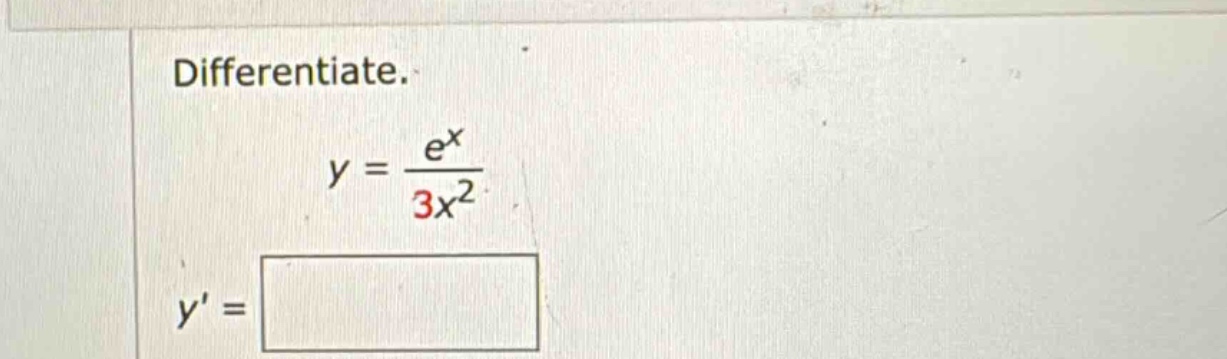
differentiate. y = e^x / 3x^2 y =
Answer
Explanation:
Step1: Recall quotient - rule
The quotient - rule states that if $y=\frac{u}{v}$, then $y'=\frac{u'v - uv'}{v^{2}}$. Here, $u = e^{x}$ and $v = 3x^{2}$.
Step2: Find $u'$ and $v'$
The derivative of $u = e^{x}$ is $u'=e^{x}$ (since the derivative of $e^{x}$ with respect to $x$ is $e^{x}$), and the derivative of $v = 3x^{2}$ is $v'=6x$ (using the power - rule $\frac{d}{dx}(ax^{n})=nax^{n - 1}$, where $a = 3$ and $n = 2$).
Step3: Apply the quotient - rule
$y'=\frac{e^{x}\cdot3x^{2}-e^{x}\cdot6x}{(3x^{2})^{2}}$.
Step4: Simplify the expression
First, factor out $e^{x}x$ from the numerator: $y'=\frac{e^{x}x(3x - 6)}{9x^{4}}$. Then, cancel out an $x$ from the numerator and denominator: $y'=\frac{e^{x}(3x - 6)}{9x^{3}}=\frac{e^{x}(x - 2)}{3x^{3}}$.
Answer:
$\frac{e^{x}(x - 2)}{3x^{3}}$