differentiate. (assume c is a constant.) z = v^3/2(v + ce^v) z =
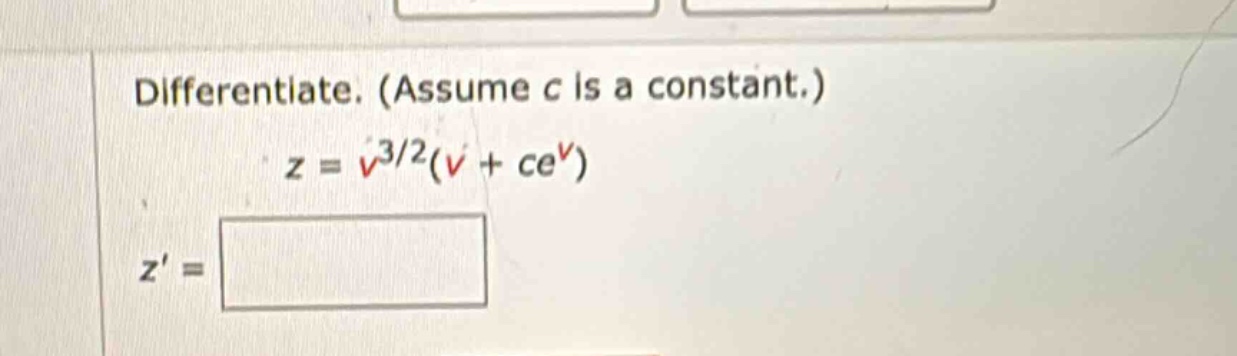
differentiate. (assume c is a constant.) z = v^3/2(v + ce^v) z =
Answer
Explanation:
Step1: Apply product - rule
The product - rule states that if $z = u\cdot v$, then $z'=u'v + uv'$. Let $u = v^{3/2}$ and $v=v + ce^{v}$.
Step2: Differentiate $u$
Using the power - rule $\frac{d}{dv}(v^{n})=nv^{n - 1}$, for $u = v^{3/2}$, we have $u'=\frac{3}{2}v^{3/2 - 1}=\frac{3}{2}v^{1/2}$.
Step3: Differentiate $v$
Differentiating $v = v+ce^{v}$ with respect to $v$, we get $v'=1 + ce^{v}$ (since $\frac{d}{dv}(v)=1$ and $\frac{d}{dv}(ce^{v})=ce^{v}$).
Step4: Calculate $z'$
By the product - rule $z'=u'v + uv'$. [ \begin{align*} z'&=\frac{3}{2}v^{1/2}(v + ce^{v})+v^{3/2}(1 + ce^{v})\ &=\frac{3}{2}v^{3/2}+\frac{3}{2}cv^{1/2}e^{v}+v^{3/2}+cv^{3/2}e^{v}\ &=(\frac{3}{2}+ 1)v^{3/2}+(\frac{3}{2}v^{1/2}+v^{3/2})ce^{v}\ &=\frac{5}{2}v^{3/2}+(\frac{3}{2}v^{1/2}+v^{3/2})ce^{v} \end{align*} ]
Answer:
$\frac{5}{2}v^{3/2}+(\frac{3}{2}v^{1/2}+v^{3/2})ce^{v}$