differentiate the function. h(z) = ln √(b² - z²)/(b² + z²) h(z) =
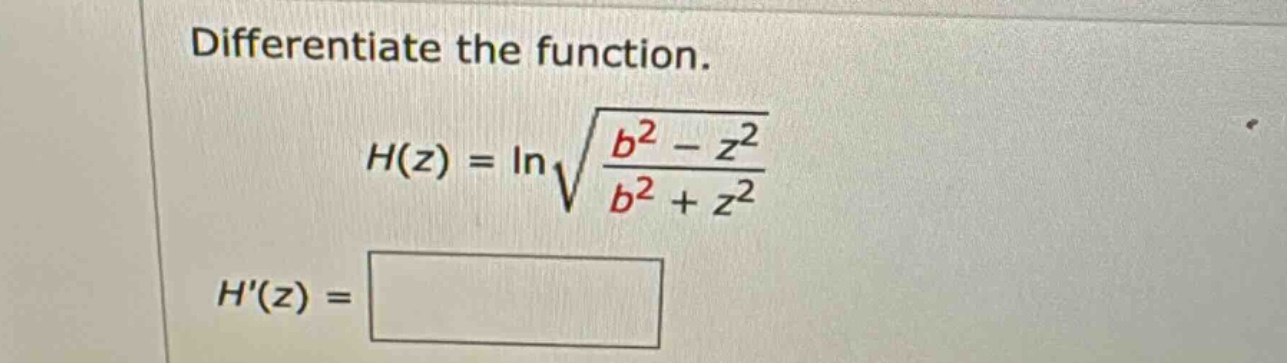
differentiate the function. h(z) = ln √(b² - z²)/(b² + z²) h(z) =
Answer
Explanation:
Step1: Simplify the function
First, use the property of logarithms $\ln\sqrt{u}=\frac{1}{2}\ln u$. So, $H(z)=\frac{1}{2}\ln\frac{b^{2}-z^{2}}{b^{2}+z^{2}}$. Then use the property $\ln\frac{u}{v}=\ln u-\ln v$, we get $H(z)=\frac{1}{2}(\ln(b^{2}-z^{2})-\ln(b^{2}+z^{2}))$.
Step2: Apply the chain - rule
The derivative of $\ln(u)$ with respect to $z$ is $\frac{u'}{u}$ by the chain - rule. For $y = \ln(b^{2}-z^{2})$, $u = b^{2}-z^{2}$, $u'=-2z$, so $y'=\frac{-2z}{b^{2}-z^{2}}$. For $y=\ln(b^{2}+z^{2})$, $u = b^{2}+z^{2}$, $u' = 2z$, so $y'=\frac{2z}{b^{2}+z^{2}}$.
Step3: Differentiate $H(z)$
$H'(z)=\frac{1}{2}(\frac{-2z}{b^{2}-z^{2}}-\frac{2z}{b^{2}+z^{2}})$.
Step4: Combine the fractions
$H'(z)=\frac{1}{2}\frac{-2z(b^{2}+z^{2})-2z(b^{2}-z^{2})}{(b^{2}-z^{2})(b^{2}+z^{2})}=\frac{-2zb^{2}-2z^{3}-2zb^{2}+2z^{3}}{2(b^{4}-z^{4})}=\frac{-2zb^{2}}{b^{4}-z^{4}}$.
Answer:
$\frac{-2zb^{2}}{b^{4}-z^{4}}$