differentiate the function. y = ln(e^(-x) + xe^(-x)) y =
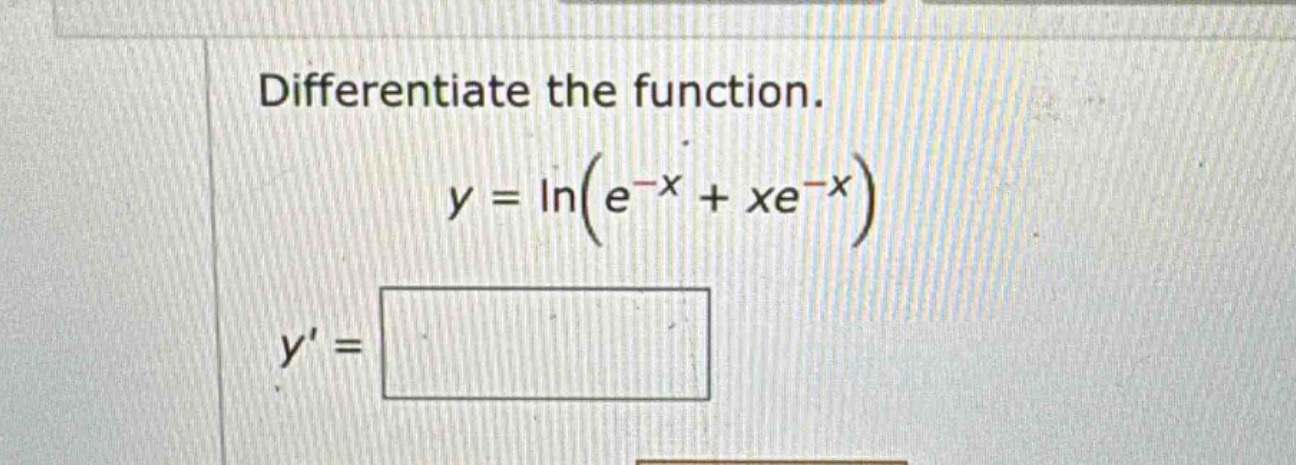
differentiate the function. y = ln(e^(-x) + xe^(-x)) y =
Answer
Explanation:
Step1: Use chain - rule
Let $u = e^{-x}+xe^{-x}$. Then $y=\ln(u)$ and by the chain - rule $y'=\frac{u'}{u}$.
Step2: Find the derivative of $u$
First, find the derivative of $e^{-x}$ and $xe^{-x}$ separately. The derivative of $e^{-x}$ using the chain - rule is $-e^{-x}$. For $xe^{-x}$, use the product rule $(uv)' = u'v + uv'$, where $u = x$ and $v = e^{-x}$. So $(xe^{-x})'=e^{-x}-xe^{-x}$. Then $u'=-e^{-x}+e^{-x}-xe^{-x}=-xe^{-x}$.
Step3: Calculate $y'$
Since $u = e^{-x}+xe^{-x}=e^{-x}(1 + x)$ and $u'=-xe^{-x}$, then $y'=\frac{-xe^{-x}}{e^{-x}(1 + x)}=\frac{-x}{1 + x}$.
Answer:
$\frac{-x}{1 + x}$