(a) differentiate the given equation implicitly and then solve for y. (b) solve the given equation for y and…
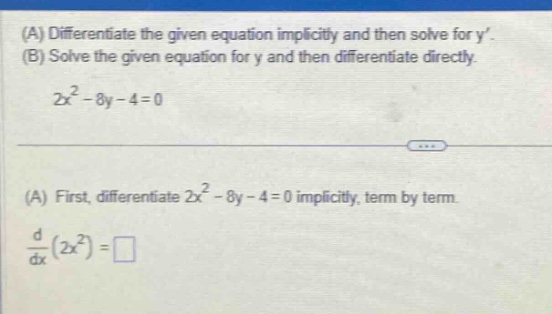
(a) differentiate the given equation implicitly and then solve for y. (b) solve the given equation for y and then differentiate directly. 2x² - 8y - 4 = 0 (a) first, differentiate 2x² - 8y - 4 = 0 implicitly, term by term. $\frac{d}{dx}(2x^{2})=square$
Answer
Explanation:
Step1: Differentiate $2x^{2}$
Using the power - rule $\frac{d}{dx}(ax^{n})=nax^{n - 1}$, for $a = 2$ and $n = 2$, we have $\frac{d}{dx}(2x^{2})=4x$.
Step2: Differentiate $-8y$
Using the chain - rule, $\frac{d}{dx}(-8y)=-8y'$.
Step3: Differentiate $-4$
The derivative of a constant is 0, so $\frac{d}{dx}(-4) = 0$.
Step4: Set up the differentiated equation
Differentiating $2x^{2}-8y - 4=0$ term - by - term gives $4x-8y'-0 = 0$.
Step5: Solve for $y'$
First, isolate the term with $y'$: $8y'=4x$. Then divide both sides by 8 to get $y'=\frac{4x}{8}=\frac{x}{2}$.
Answer:
$y'=\frac{x}{2}$