directions: drag the correct answers to the boxes. identify the increasing and decreasing intervals of the…
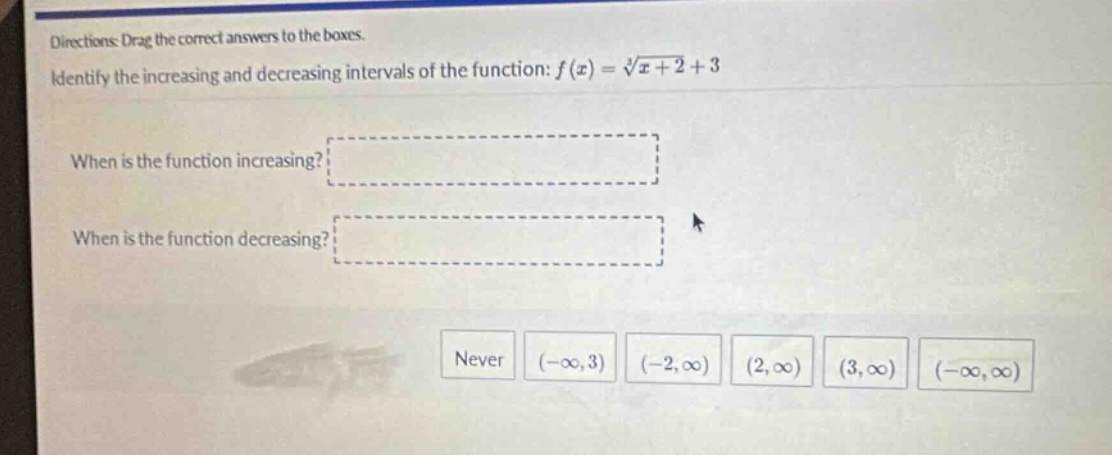
directions: drag the correct answers to the boxes. identify the increasing and decreasing intervals of the function: f(x) = ∛(x + 2)+3 when is the function increasing? when is the function decreasing? never (-∞,3) (-2,∞) (2,∞) (3,∞) (-∞,∞)
Answer
Explanation:
Step1: Recall cube - root function property
The parent cube - root function $y = \sqrt[3]{u}$ is increasing for all real values of $u$. Let $u=x + 2$.
Step2: Analyze the given function
The function $f(x)=\sqrt[3]{x + 2}+3$ is a transformation of the parent cube - root function $y=\sqrt[3]{x}$. The domain of $f(x)$ is all real numbers since we can take the cube - root of any real number. The cube - root function $y=\sqrt[3]{u}$ is increasing for all $u\in(-\infty,\infty)$. For $u=x + 2$, as $x$ increases, $u$ increases and $\sqrt[3]{u}$ increases.
Answer:
When is the function increasing? $(-\infty,\infty)$ When is the function decreasing? Never