directions: graph each function and identify its key characteristics.\n9. $f(x) = x^3 - 10x^2 + 27x…
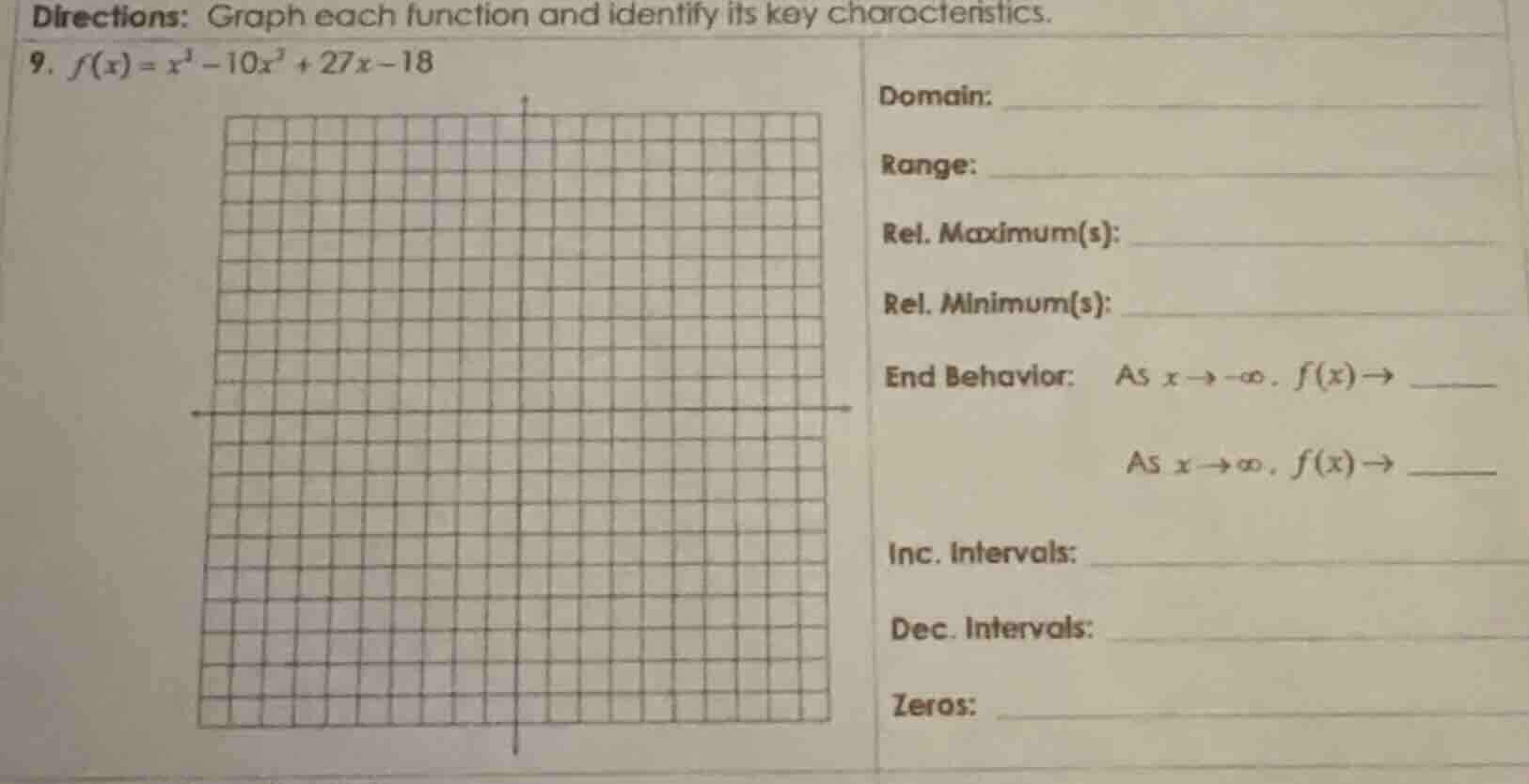
directions: graph each function and identify its key characteristics.\n9. $f(x) = x^3 - 10x^2 + 27x - 18$\ndomain:\nrange:\nrel. maximum(s):\nrel. minimum(s):\nend behavior: as $x \\to -\\infty, f(x) \\to \\underline{\\quad}$\nas $x \\to \\infty, f(x) \\to \\underline{\\quad}$\ninc. intervals:\ndec. intervals:\nzeros:
Answer
Explanation:
Step1: Identify domain and range
Polynomial functions are defined for all real numbers. Domain: $(-\infty, \infty)$; Range: $(-\infty, \infty)$
Step2: Find the zeros
Factor $f(x) = x^3 - 10x^2 + 27x - 18$ using the Rational Root Theorem. $f(x) = (x-1)(x-3)(x-6) = 0 \implies x = 1, 3, 6$
Step3: Determine end behavior
Check the leading term $x^3$ as $x$ approaches infinity. As $x \to -\infty, f(x) \to -\infty$; As $x \to \infty, f(x) \to \infty$
Step4: Find critical points
Differentiate $f(x)$ and set to zero to find extrema. $f'(x) = 3x^2 - 20x + 27 = 0 \implies x = \frac{20 \pm \sqrt{400 - 324}}{6} \approx 1.88, 4.79$
Step5: Calculate relative extrema
Evaluate $f(x)$ at critical points. $f(1.88) \approx 4.06$ (Rel. Max); $f(4.79) \approx -8.21$ (Rel. Min)
Step6: Determine intervals
Identify where the derivative is positive or negative. Inc: $(-\infty, 1.88) \cup (4.79, \infty)$; Dec: $(1.88, 4.79)$
Answer:
Domain: $(-\infty, \infty)$ Range: $(-\infty, \infty)$ Rel. Maximum(s): $(1.88, 4.06)$ Rel. Minimum(s): $(4.79, -8.21)$ End Behavior: As $x \to -\infty, f(x) \to -\infty$; As $x \to \infty, f(x) \to \infty$ Inc. Intervals: $(-\infty, 1.88) \cup (4.79, \infty)$ Dec. Intervals: $(1.88, 4.79)$ Zeros: $x = 1, 3, 6$