directions: use the limit definition of a derivative to find the derivative of each given function. show all…
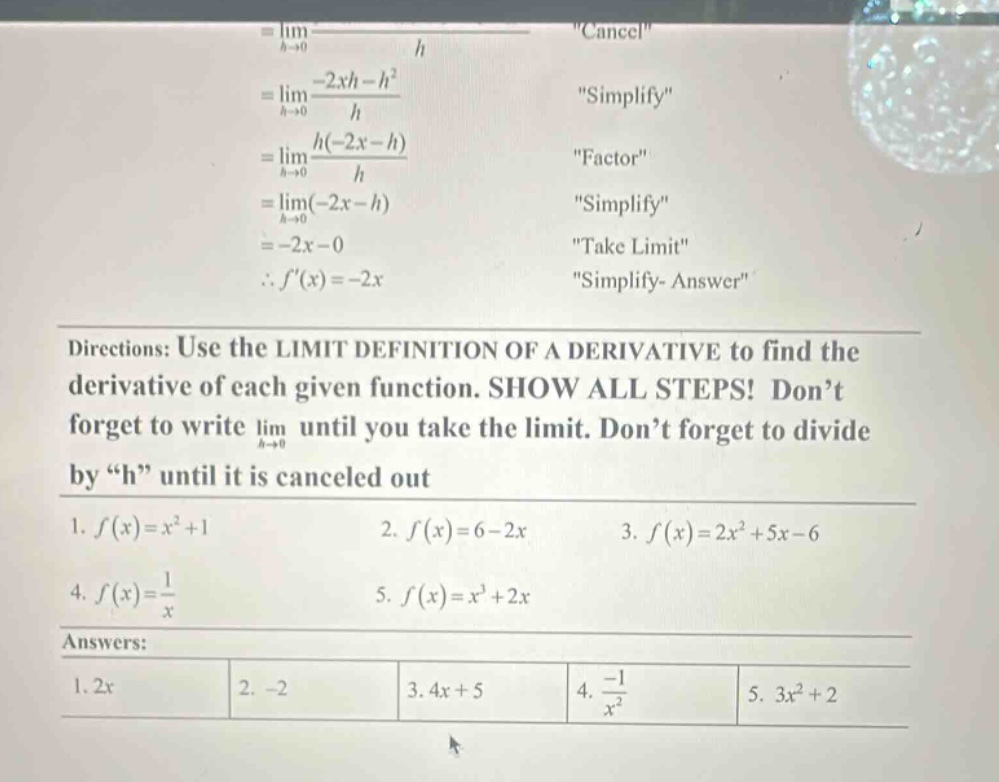
directions: use the limit definition of a derivative to find the derivative of each given function. show all steps! don’t forget to write $lim_{h \to 0}$ until you take the limit. don’t forget to divide by “h” until it is canceled out\n1. $f(x)=x^{2}+1$ 2. $f(x)=6 - 2x$ 3. $f(x)=2x^{2}+5x - 6$\n4. $f(x)=\frac{1}{x}$ 5. $f(x)=x^{3}+2x$\nanswers:\n1. $2x$ 2. $-2$ 3. $4x + 5$ 4. $-\frac{1}{x^{2}}$ 5. $3x^{2}+2$
Answer
- For (f(x)=x^{2}+1):
-
Explanation:
-
Step1: Write the limit - definition of the derivative formula
The limit - definition of the derivative is (f^{\prime}(x)=\lim_{h\rightarrow0}\frac{f(x + h)-f(x)}{h}). First, find (f(x + h)): (f(x + h)=(x + h)^{2}+1=x^{2}+2xh+h^{2}+1). Then (f(x + h)-f(x)=(x^{2}+2xh+h^{2}+1)-(x^{2}+1)=2xh + h^{2}). So, (\frac{f(x + h)-f(x)}{h}=\frac{2xh+h^{2}}{h}). -
Step2: Simplify the expression
(\frac{2xh + h^{2}}{h}=\frac{h(2x + h)}{h}=2x+h) (since (h\neq0) when taking the limit). -
Step3: Take the limit
(f^{\prime}(x)=\lim_{h\rightarrow0}(2x + h)=2x+0 = 2x).
-
-
- For (f(x)=6 - 2x):
-
Explanation:
-
Step1: Find (f(x + h))
(f(x + h)=6-2(x + h)=6-2x-2h). Then (f(x + h)-f(x)=(6-2x-2h)-(6 - 2x)=-2h). So, (\frac{f(x + h)-f(x)}{h}=\frac{-2h}{h}). -
Step2: Simplify the expression
(\frac{-2h}{h}=-2) (since (h\neq0) when taking the limit). -
Step3: Take the limit
(f^{\prime}(x)=\lim_{h\rightarrow0}(-2)=-2).
-
-
- For (f(x)=2x^{2}+5x - 6):
-
Explanation:
-
Step1: Find (f(x + h))
(f(x + h)=2(x + h)^{2}+5(x + h)-6=2(x^{2}+2xh+h^{2})+5x + 5h-6=2x^{2}+4xh+2h^{2}+5x + 5h-6). Then (f(x + h)-f(x)=(2x^{2}+4xh+2h^{2}+5x + 5h-6)-(2x^{2}+5x - 6)=4xh+2h^{2}+5h). So, (\frac{f(x + h)-f(x)}{h}=\frac{4xh+2h^{2}+5h}{h}). -
Step2: Simplify the expression
(\frac{4xh+2h^{2}+5h}{h}=\frac{h(4x + 2h+5)}{h}=4x + 2h+5) (since (h\neq0) when taking the limit). -
Step3: Take the limit
(f^{\prime}(x)=\lim_{h\rightarrow0}(4x + 2h+5)=4x+5).
-
-
- For (f(x)=\frac{1}{x}):
-
Explanation:
-
Step1: Find (f(x + h))
(f(x + h)=\frac{1}{x + h}). Then (f(x + h)-f(x)=\frac{1}{x + h}-\frac{1}{x}=\frac{x-(x + h)}{x(x + h)}=\frac{x - x - h}{x(x + h)}=\frac{-h}{x(x + h)}). So, (\frac{f(x + h)-f(x)}{h}=\frac{\frac{-h}{x(x + h)}}{h}). -
Step2: Simplify the expression
(\frac{\frac{-h}{x(x + h)}}{h}=\frac{-h}{x(x + h)\cdot h}=-\frac{1}{x(x + h)}) (since (h\neq0) when taking the limit). -
Step3: Take the limit
(f^{\prime}(x)=\lim_{h\rightarrow0}-\frac{1}{x(x + h)}=-\frac{1}{x^{2}}).
-
-
- For (f(x)=x^{3}+2x):
-
Explanation:
-
Step1: Find (f(x + h))
(f(x + h)=(x + h)^{3}+2(x + h)=x^{3}+3x^{2}h + 3xh^{2}+h^{3}+2x+2h). Then (f(x + h)-f(x)=(x^{3}+3x^{2}h + 3xh^{2}+h^{3}+2x+2h)-(x^{3}+2x)=3x^{2}h+3xh^{2}+h^{3}+2h). So, (\frac{f(x + h)-f(x)}{h}=\frac{3x^{2}h+3xh^{2}+h^{3}+2h}{h}). -
Step2: Simplify the expression
(\frac{3x^{2}h+3xh^{2}+h^{3}+2h}{h}=\frac{h(3x^{2}+3xh + h^{2}+2)}{h}=3x^{2}+3xh + h^{2}+2) (since (h\neq0) when taking the limit). -
Step3: Take the limit
(f^{\prime}(x)=\lim_{h\rightarrow0}(3x^{2}+3xh + h^{2}+2)=3x^{2}+2).
-
-
Answer:
- (2x)
- (-2)
- (4x + 5)
- (-\frac{1}{x^{2}})
- (3x^{2}+2)