divergence, integral & p - series tests\n5. for each of the series below, see if the divergence test…
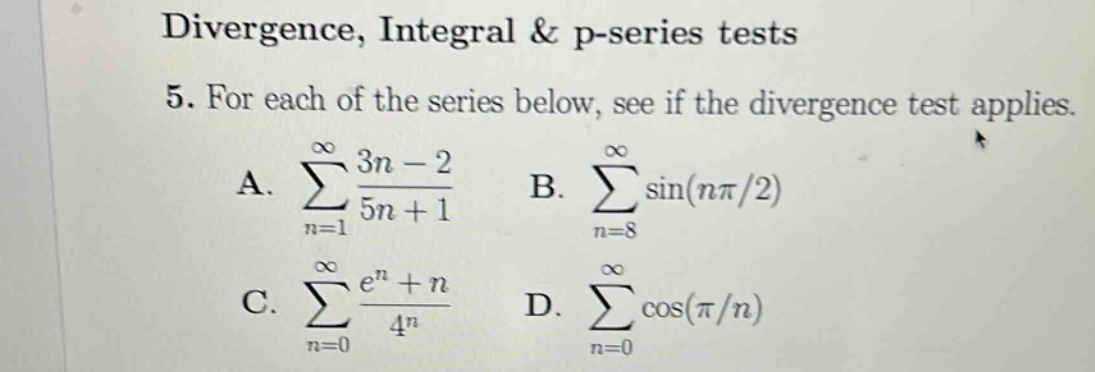
divergence, integral & p - series tests\n5. for each of the series below, see if the divergence test applies.\na. ∑(n = 1)^∞ (3n - 2)/(5n + 1)\nb. ∑(n = 8)^∞ sin(nπ/2)\nc. ∑(n = 0)^∞ (e^n + n)/4^n\nd. ∑(n = 0)^∞ cos(π/n)
Answer
Explanation:
Step1: Recall divergence - test
The divergence - test states that if $\lim_{n\rightarrow\infty}a_{n}\neq0$, then the series $\sum_{n = 1}^{\infty}a_{n}$ diverges.
Step2: Analyze series A
For the series $\sum_{n = 1}^{\infty}\frac{3n - 2}{5n+1}$, find $\lim_{n\rightarrow\infty}\frac{3n - 2}{5n+1}$. Divide numerator and denominator by $n$: $\lim_{n\rightarrow\infty}\frac{3-\frac{2}{n}}{5+\frac{1}{n}}=\frac{3 - 0}{5+0}=\frac{3}{5}\neq0$. So the divergence - test applies and the series diverges.
Step3: Analyze series B
For the series $\sum_{n = 8}^{\infty}\sin(n\pi/2)$. Consider the sequence $a_{n}=\sin(n\pi/2)$. When $n = 8$, $a_{8}=\sin(4\pi)=0$; when $n = 9$, $a_{9}=\sin(9\pi/2)=1$; when $n = 10$, $a_{10}=\sin(5\pi)=0$; when $n = 11$, $a_{11}=\sin(11\pi/2)= - 1$. The sequence ${a_{n}}$ does not have a limit as $n\rightarrow\infty$, and in particular $\lim_{n\rightarrow\infty}\sin(n\pi/2)$ does not exist and is not equal to $0$. So the divergence - test applies.
Step4: Analyze series C
For the series $\sum_{n = 0}^{\infty}\frac{e^{n}+n}{4^{n}}=\sum_{n = 0}^{\infty}(\frac{e}{4})^{n}+\sum_{n = 0}^{\infty}\frac{n}{4^{n}}$. First, find $\lim_{n\rightarrow\infty}\frac{e^{n}+n}{4^{n}}$. Since $e\approx2.718$, $\lim_{n\rightarrow\infty}\frac{e^{n}+n}{4^{n}}=\lim_{n\rightarrow\infty}(\frac{e}{4})^{n}+\lim_{n\rightarrow\infty}\frac{n}{4^{n}}$. We know that $\lim_{n\rightarrow\infty}(\frac{e}{4})^{n}=0$ and using L'Hopital's rule for $\lim_{n\rightarrow\infty}\frac{n}{4^{n}}$ (write $y = \frac{n}{4^{n}}$, then $\ln y=\ln n - n\ln4$, and $\lim_{n\rightarrow\infty}\ln y=-\infty$, so $\lim_{n\rightarrow\infty}y = 0$). So $\lim_{n\rightarrow\infty}\frac{e^{n}+n}{4^{n}}=0$, and the divergence - test does not apply.
Step5: Analyze series D
For the series $\sum_{n = 0}^{\infty}\cos(\pi/n)$, find $\lim_{n\rightarrow\infty}\cos(\pi/n)$. As $n\rightarrow\infty$, $\frac{\pi}{n}\rightarrow0$, and $\lim_{n\rightarrow\infty}\cos(\pi/n)=\cos(0)=1\neq0$. So the divergence - test applies.
Answer:
The divergence - test applies to series A, B, and D.