dividing example 6 another possible option would have been to write lim x→0+ x ln x = lim x→0+ x / (1/ln x)…
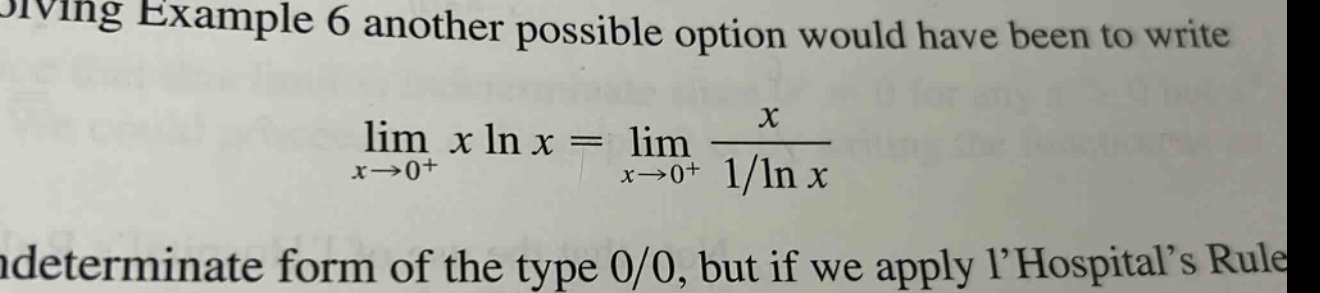
dividing example 6 another possible option would have been to write lim x→0+ x ln x = lim x→0+ x / (1/ln x) indeterminate form of the type 0/0, but if we apply l’hospital’s rule
Answer
Explanation:
Step1: Identify the form
The original limit $\lim_{x\rightarrow0^{+}}x\ln x$ is in the $0\times\infty$ form. By rewriting it as $\lim_{x\rightarrow0^{+}}\frac{x}{1/\ln x}$, it becomes a $\frac{0}{0}$ indeterminate - form, which allows the use of L'Hopital's Rule.
Step2: Apply L'Hopital's Rule
Differentiate the numerator and denominator. The derivative of $y = x$ is $y'=1$, and the derivative of $y=\frac{1}{\ln x}=(\ln x)^{-1}$ using the chain - rule: $y'=-\frac{1}{x(\ln x)^{2}}$. So, $\lim_{x\rightarrow0^{+}}\frac{x}{1/\ln x}=\lim_{x\rightarrow0^{+}}\frac{1}{-\frac{1}{x(\ln x)^{2}}}=\lim_{x\rightarrow0^{+}}-x(\ln x)^{2}$.
Step3: Analyze the new limit
As $x\rightarrow0^{+}$, $x\rightarrow0$ and $(\ln x)^{2}\rightarrow+\infty$. But we can rewrite $-x(\ln x)^{2}=-\frac{(\ln x)^{2}}{1/x}$ which is again in the $\frac{\infty}{\infty}$ form.
Step4: Apply L'Hopital's Rule again
Differentiate the numerator and denominator. The derivative of $y = (\ln x)^{2}$ is $y'=\frac{2\ln x}{x}$ by the chain - rule, and the derivative of $y=\frac{1}{x}$ is $y'=-\frac{1}{x^{2}}$. Then $\lim_{x\rightarrow0^{+}}-\frac{(\ln x)^{2}}{1/x}=\lim_{x\rightarrow0^{+}}\frac{2\ln x/x}{1/x^{2}}=\lim_{x\rightarrow0^{+}}2x\ln x$.
Step5: Apply L'Hopital's Rule one more time (if needed)
We can rewrite $2x\ln x$ as $\frac{2\ln x}{1/x}$ (in $\frac{-\infty}{\infty}$ form). Differentiating, the derivative of $y = 2\ln x$ is $y'=\frac{2}{x}$, and the derivative of $y=\frac{1}{x}$ is $y'=-\frac{1}{x^{2}}$. So, $\lim_{x\rightarrow0^{+}}\frac{2\ln x}{1/x}=\lim_{x\rightarrow0^{+}}\frac{2/x}{-1/x^{2}}=\lim_{x\rightarrow0^{+}}- 2x = 0$.
Answer:
$0$