(a) the domain of the function is (0,oo). (type your answer in interval notation.) (b) determine the y…
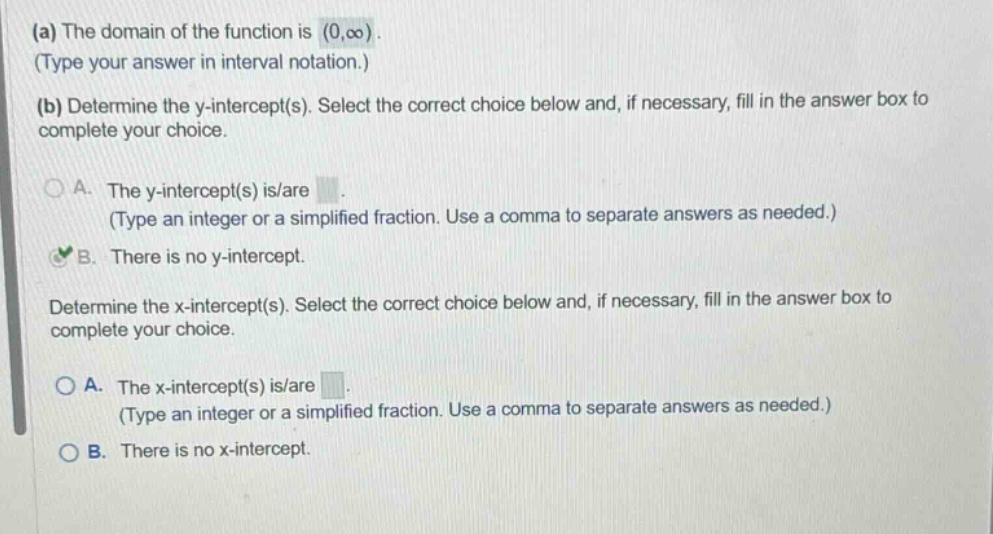
(a) the domain of the function is (0,oo). (type your answer in interval notation.) (b) determine the y - intercept(s). select the correct choice below and, if necessary, fill in the answer box to complete your choice. a. the y - intercept(s) is/are (type an integer or a simplified fraction. use a comma to separate answers as needed.) b. there is no y - intercept. determine the x - intercept(s). select the correct choice below and, if necessary, fill in the answer box to complete your choice. a. the x - intercept(s) is/are (type an integer or a simplified fraction. use a comma to separate answers as needed.) b. there is no x - intercept.
Answer
Explanation:
Step1: Recall y - intercept definition
The y - intercept is found by setting (x = 0). Since the domain of the function is ((0,\infty)), (x) cannot be (0). So there is no y - intercept.
Step2: Recall x - intercept definition
The x - intercept is found by setting (y=0). Without knowing the function, we assume we solve the equation (f(x)=0). Let's assume we have a function (y = f(x)). We set (y = 0) and solve for (x). If there are solutions (x=a) such that (a\in(0,\infty)), those are the x - intercepts. But we need the function to actually solve. However, if the function has no roots in the domain ((0,\infty)), there is no x - intercept.
Answer:
b) B. There is no y - intercept. c) Without the function, we cannot determine. If we assume no roots in ((0,\infty)) based on lack of information, B. There is no x - intercept.