what are the domain and range of the logarithmic function (f(x)=log_{2}x)? use the inverse function to…
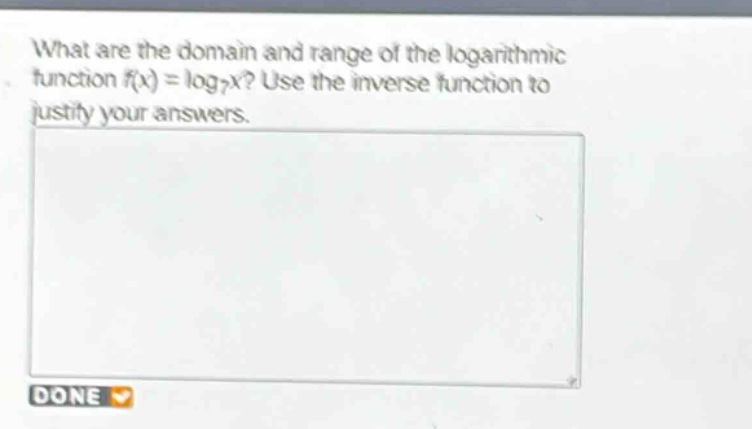
what are the domain and range of the logarithmic function (f(x)=log_{2}x)? use the inverse function to justify your answers.
Answer
Explanation:
Step1: Recall the definition of the logarithmic function
The logarithmic function (y = \log_{a}x) is defined as the inverse of the exponential function (y=a^{x}). For the function (y = \log_{2}x), the exponential - form is (x = 2^{y}).
Step2: Find the domain
The argument of a logarithmic function must be positive. In the function (y=\log_{2}x), (x>0). So the domain of (y = \log_{2}x) is the set of all positive real numbers, which can be written in interval notation as ((0,+\infty)).
Step3: Find the range using the inverse function
The inverse of (y=\log_{2}x) is (x = 2^{y}). The exponential function (y = 2^{x}) (or in our case (x = 2^{y})) can take on any positive real - valued output for all real values of the exponent. Since (y) (the output of the logarithmic function) can be any real number for the exponential function (x = 2^{y}) to cover all positive real values of (x), the range of (y=\log_{2}x) is the set of all real numbers, which can be written in interval notation as ((-\infty,+\infty)).
Answer:
Domain: ((0,+\infty)); Range: ((-\infty,+\infty))