dont forget to shift the graph.\nusing function notation, i.e. f(x) =, enter the function that results from…
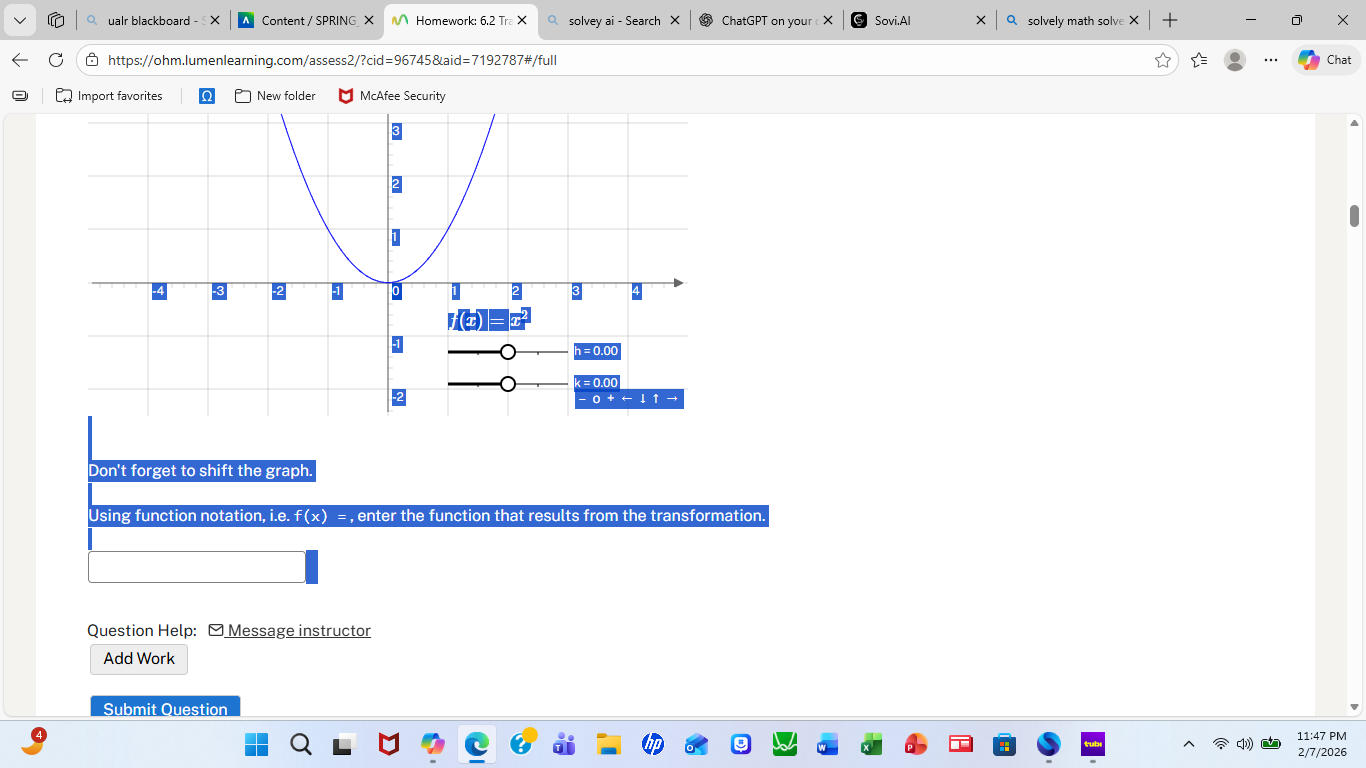
dont forget to shift the graph.\nusing function notation, i.e. f(x) =, enter the function that results from the transformation.\nquestion help: ✉ message instructor\nadd work\nsubmit question
Answer
Explanation:
Step1: Identify the original function
The original function is ( f(x) = x^2 ).
Step2: Analyze the transformations
From the given sliders, ( h = 0.00 ) and ( k = 0.00 ), but wait, maybe there's a mis - reading. Wait, the graph transformation: if we look at the movement, but maybe the intended transformation is a shift? Wait, no, maybe the sliders are for horizontal and vertical shifts. Wait, the original function is ( y=x^2 ). If there is a horizontal shift ( h ) and vertical shift ( k ), the transformed function is ( y=(x - h)^2+k ). But in the given, if ( h = 0 ) and ( k = 0 ), but that can't be. Wait, maybe the user made a mistake in the screenshot, but wait, maybe the actual transformation is a shift. Wait, no, maybe the problem is about shifting. Wait, maybe the intended transformation is, for example, if we shift the graph. Wait, maybe the sliders are set to ( h = 0 ) and ( k = 0 ), but that would mean no shift. But that seems odd. Wait, maybe the original function is ( f(x)=x^2 ), and if we shift it, but maybe the problem is a typo. Wait, no, maybe the user wants to write the function as ( f(x)=x^2 ) if there is no shift. But that seems unlikely. Wait, maybe the sliders are for ( h ) (horizontal shift) and ( k ) (vertical shift). The general form of a transformed quadratic function is ( f(x)=(x - h)^2 + k ). If ( h = 0 ) and ( k = 0 ), then ( f(x)=x^2 ). But maybe the problem has a different intention. Wait, maybe the user made a mistake in the screenshot, but based on the given, if there is no shift, the function remains ( f(x)=x^2 ).
Answer:
( f(x)=x^2 )