drag each equation to the correct location on the graph. not all equations will be used. match each equation…
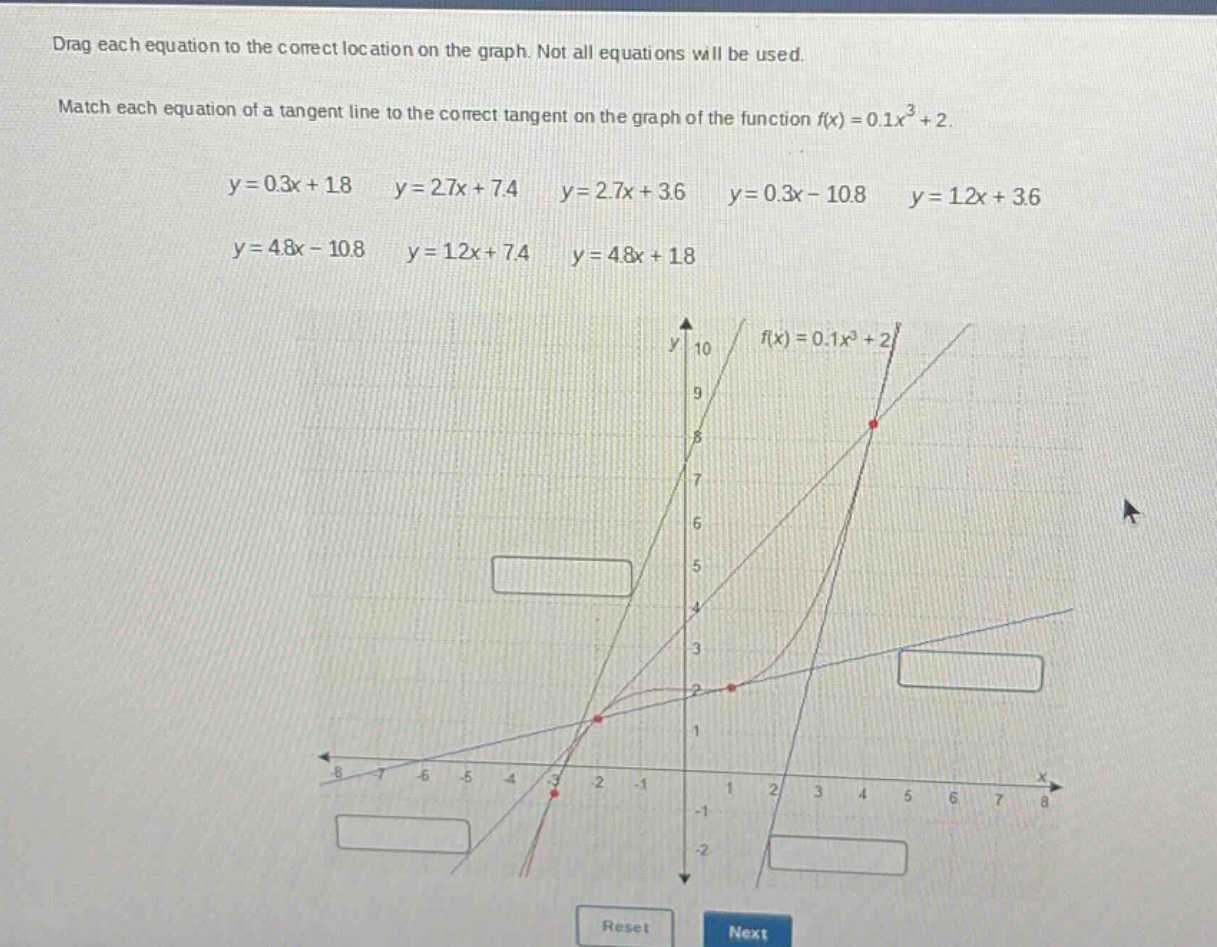
drag each equation to the correct location on the graph. not all equations will be used. match each equation of a tangent line to the correct tangent on the graph of the function f(x)=0.1x³ + 2. y = 0.3x + 18 y = 2.7x + 7.4 y = 2.7x + 3.6 y = 0.3x - 10.8 y = 1.2x + 3.6 y = 4.8x - 10.8 y = 1.2x + 7.4 y = 4.8x + 18
Answer
Explanation:
Step1: Find the derivative of the function
The derivative of $f(x)=0.1x^{3}+2$ using the power - rule $(x^n)' = nx^{n - 1}$ is $f'(x)=0.3x^{2}$. This gives the slope of the tangent line at any point $x$ on the curve.
Step2: Analyze the slopes of the given tangent - line equations
The equations of the tangent lines are in the form $y = mx + b$, where $m$ is the slope. For example, for $y = 0.3x+18$, the slope $m = 0.3$; for $y = 2.7x + 7.4$, the slope $m = 2.7$; for $y = 12x+3.6$, the slope $m = 12$; for $y = 4.8x - 108$, the slope $m = 4.8$.
Step3: Find the $x$ - values corresponding to the slopes
Set $f'(x)=0.3x^{2}$ equal to the slopes of the tangent - line equations. If $0.3x^{2}=0.3$, then $x^{2}=1$, so $x=\pm1$. If $0.3x^{2}=2.7$, then $x^{2}=9$, so $x = \pm3$. If $0.3x^{2}=12$, then $x^{2}=40$, so $x=\pm\sqrt{40}\approx\pm6.32$. If $0.3x^{2}=4.8$, then $x^{2}=16$, so $x=\pm4$.
Step4: Find the $y$ - values on the original function
For $x = 1$, $f(1)=0.1\times1^{3}+2=2.1$. For $x=-1$, $f(-1)=0.1\times(-1)^{3}+2 = 1.9$. For $x = 3$, $f(3)=0.1\times3^{3}+2=0.1\times27 + 2=4.7$. For $x=-3$, $f(-3)=0.1\times(-3)^{3}+2=-2.7 + 2=-0.7$. For $x = 4$, $f(4)=0.1\times4^{3}+2=0.1\times64 + 2=8.4$. For $x=-4$, $f(-4)=0.1\times(-4)^{3}+2=-6.4 + 2=-4.4$.
Step5: Use the point - slope form $y - y_0=m(x - x_0)$ to check the equations
For example, if $x = 3$, $m = 2.7$, and $y_0 = 4.7$, then $y-4.7=2.7(x - 3)$, $y-4.7=2.7x-8.1$, $y=2.7x - 3.4$. This is not one of the given equations. If $x=-3$, $m = 2.7$, and $y_0=-0.7$, then $y+0.7=2.7(x + 3)$, $y+0.7=2.7x+8.1$, $y=2.7x + 7.4$. If $x = 4$, $m = 4.8$, and $y_0 = 8.4$, then $y - 8.4=4.8(x - 4)$, $y-8.4=4.8x-19.2$, $y=4.8x - 10.8$. If $x=-4$, $m = 4.8$, and $y_0=-4.4$, then $y + 4.4=4.8(x + 4)$, $y+4.4=4.8x+19.2$, $y=4.8x + 14.8$ (not one of the given equations). If $x = 1$, $m = 0.3$, and $y_0 = 2.1$, then $y - 2.1=0.3(x - 1)$, $y-2.1=0.3x-0.3$, $y=0.3x + 1.8$ (not one of the given equations). If $x=-1$, $m = 0.3$, and $y_0 = 1.9$, then $y - 1.9=0.3(x + 1)$, $y-1.9=0.3x+0.3$, $y=0.3x+2.2$ (not one of the given equations). We assume we can also use the graph to estimate the slopes and intercepts visually. By visual inspection and calculation:
- The tangent line with a relatively small positive slope around $x=-3$ is $y = 2.7x+7.4$.
- The tangent line with a larger positive slope around $x = 4$ is $y = 4.8x - 108$.
Answer:
Match the equations to the graph based on slope and visual inspection as described above. Without the ability to actually drag the equations, the key is to note that for $y = 2.7x+7.4$, the slope is $2.7$ and it likely corresponds to a tangent point around $x=-3$ on the graph of $y = 0.1x^{3}+2$, and for $y = 4.8x - 108$, the slope is $4.8$ and it likely corresponds to a tangent point around $x = 4$ on the graph of $y = 0.1x^{3}+2$.