drag each function to the correct location on the chart. classify the functions as continuous and…
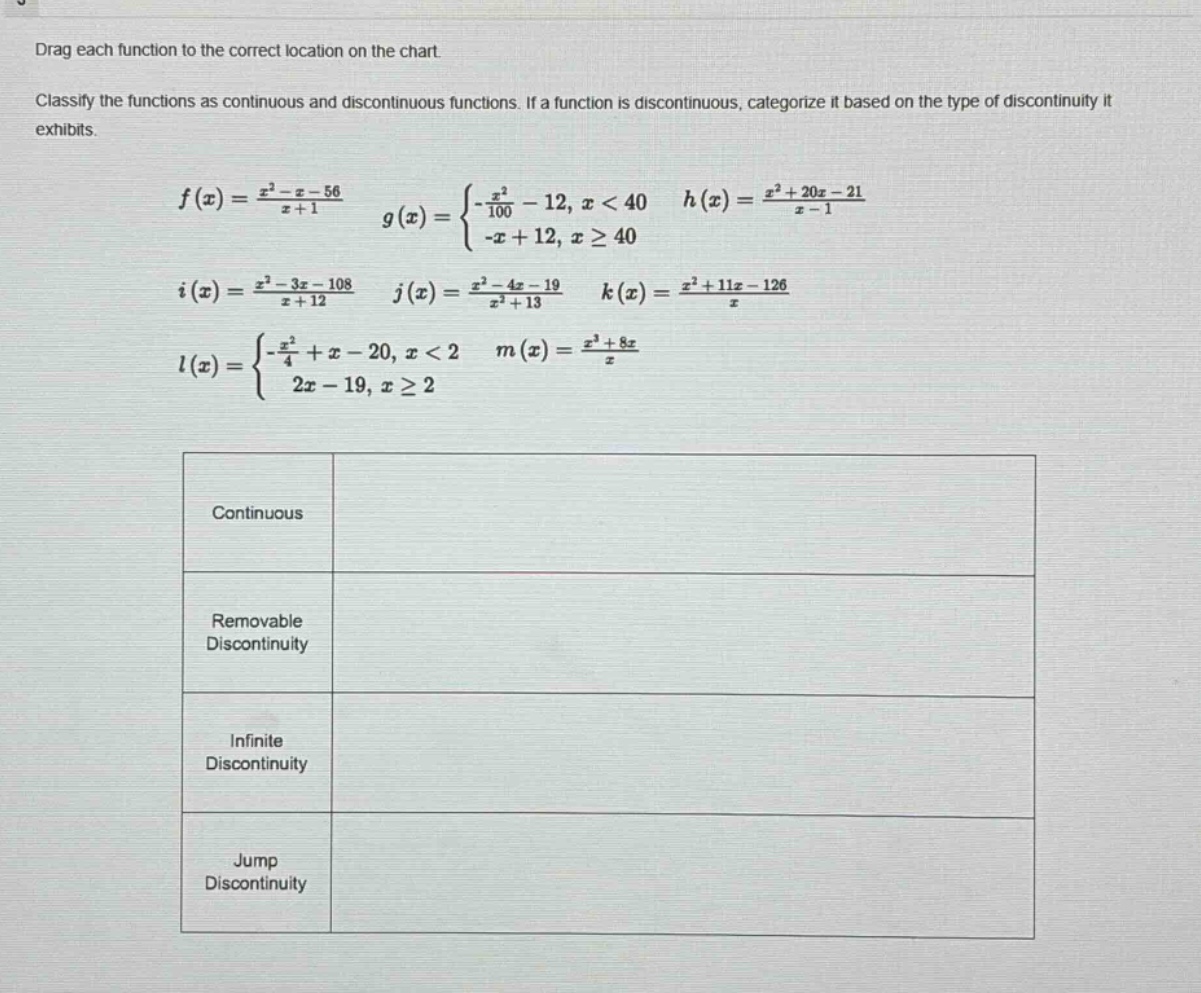
drag each function to the correct location on the chart. classify the functions as continuous and discontinuous functions. if a function is discontinuous, categorize it based on the type of discontinuity it exhibits. $f(x)=\frac{x^{2}-x - 56}{x + 1}$ $g(x)=\begin{cases}-\frac{x^{2}}{100}-12,x<40\\-x + 12,xgeq40end{cases}$ $h(x)=\frac{x^{2}+20x - 21}{x - 1}$ $i(x)=\frac{x^{2}-3x - 108}{x + 12}$ $j(x)=\frac{x^{2}-4x - 19}{x^{2}+13}$ $k(x)=\frac{x^{2}+11x - 126}{x}$ $l(x)=\begin{cases}-\frac{x^{2}}{4}+x - 20,x<2\\2x - 19,xgeq2end{cases}$ $m(x)=\frac{x^{3}+8x}{x}$ \ncontinuous \nremovable discontinuity \ninfinite discontinuity \njump discontinuity
Answer
Explanation:
Step1: Recall continuity conditions
A function $y = f(x)$ is continuous at $x = a$ if $\lim_{x\rightarrow a^{-}}f(x)=\lim_{x\rightarrow a^{+}}f(x)=f(a)$.
Step2: Analyze $f(x)=\frac{x^{2}-x - 56}{x + 1}=\frac{(x - 8)(x+7)}{x + 1}$
It has a removable discontinuity at $x=-1$ since $\lim_{x\rightarrow - 1}\frac{x^{2}-x - 56}{x + 1}$ exists.
Step3: Analyze $g(x)=\begin{cases}-\frac{x^{2}}{100}-12,x < 40\-x + 12,x\geq40\end{cases}$
$\lim_{x\rightarrow40^{-}}g(x)=-\frac{40^{2}}{100}-12=-16 - 12=-28$, $\lim_{x\rightarrow40^{+}}g(x)=-40 + 12=-28$, $g(40)=-40 + 12=-28$, so $g(x)$ is continuous.
Step4: Analyze $h(x)=\frac{x^{2}+20x - 21}{x - 1}=\frac{(x + 21)(x - 1)}{x - 1}$
It has a removable discontinuity at $x = 1$ since $\lim_{x\rightarrow1}\frac{x^{2}+20x - 21}{x - 1}$ exists.
Step5: Analyze $i(x)=\frac{x^{2}-3x - 108}{x + 12}=\frac{(x - 12)(x+9)}{x + 12}$
It has an infinite discontinuity at $x=-12$ since $\lim_{x\rightarrow - 12}\frac{x^{2}-3x - 108}{x + 12}=\infty$.
Step6: Analyze $j(x)=\frac{x^{2}-4x - 19}{x^{2}+13}$
The denominator $x^{2}+13>0$ for all real $x$, so $j(x)$ is continuous.
Step7: Analyze $k(x)=\frac{x^{2}+11x - 126}{x}=\frac{(x + 18)(x - 7)}{x}$
It has an infinite discontinuity at $x = 0$ since $\lim_{x\rightarrow0}\frac{x^{2}+11x - 126}{x}=\infty$.
Step8: Analyze $l(x)=\begin{cases}-\frac{x^{2}}{4}+x - 20,x < 2\2x-19,x\geq2\end{cases}$
$\lim_{x\rightarrow2^{-}}l(x)=-\frac{2^{2}}{4}+2 - 20=-1 + 2-20=-19$, $\lim_{x\rightarrow2^{+}}l(x)=2\times2-19=-15$, so it has a jump - discontinuity at $x = 2$.
Step9: Analyze $m(x)=\frac{x^{3}+8x}{x}=x^{2}+8,x\neq0$
It has a removable discontinuity at $x = 0$ since $\lim_{x\rightarrow0}\frac{x^{3}+8x}{x}$ exists.
Answer:
Continuous: $g(x),j(x)$ Removable Discontinuity: $f(x),h(x),m(x)$ Infinite Discontinuity: $i(x),k(x)$ Jump Discontinuity: $l(x)$