drag each tile to the correct box. not all tiles will be used. arrange the expressions for which limits…
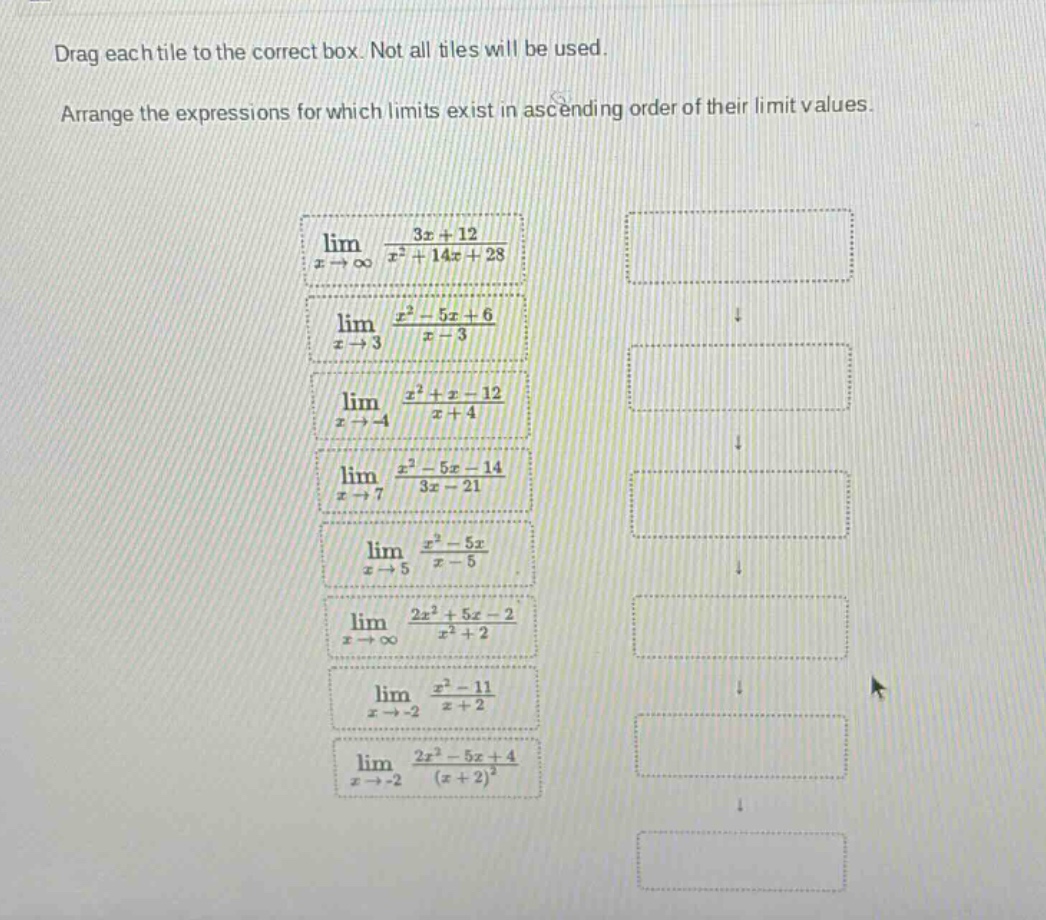
drag each tile to the correct box. not all tiles will be used. arrange the expressions for which limits exist in ascending order of their limit values. lim(x→∞) (3x + 12)/(x² + 14x + 28) lim(x→3) (x² - 5x + 6)/(x - 3) lim(x→ - 4) (x² + x - 12)/(x + 4) lim(x→7) (x² - 5x - 14)/(3x - 21) lim(x→5) (x² - 5x)/(x - 5) lim(x→∞) (2x² + 5x - 2)/(x² + 2) lim(x→ - 2) (x² - 11)/(x + 2) lim(x→ - 2) (2x² - 5x + 4)/(x + 2)²
Answer
Explanation:
Step1: Find limit of $\lim_{x\rightarrow\infty}\frac{3x + 12}{x^{2}+14x + 28}$
As $x\rightarrow\infty$, for a rational - function $\frac{f(x)}{g(x)}$ where $\text{deg}(f)=1$ and $\text{deg}(g)=2$, we use the fact that $\lim_{x\rightarrow\infty}\frac{3x + 12}{x^{2}+14x + 28}=\lim_{x\rightarrow\infty}\frac{\frac{3}{x}+\frac{12}{x^{2}}}{1+\frac{14}{x}+\frac{28}{x^{2}}}=0$.
Step2: Find limit of $\lim_{x\rightarrow3}\frac{x^{2}-5x + 6}{x - 3}$
Factor the numerator: $x^{2}-5x + 6=(x - 2)(x - 3)$. Then $\lim_{x\rightarrow3}\frac{x^{2}-5x + 6}{x - 3}=\lim_{x\rightarrow3}\frac{(x - 2)(x - 3)}{x - 3}=\lim_{x\rightarrow3}(x - 2)=1$.
Step3: Find limit of $\lim_{x\rightarrow - 4}\frac{x^{2}+x - 12}{x + 4}$
Factor the numerator: $x^{2}+x - 12=(x + 4)(x - 3)$. Then $\lim_{x\rightarrow - 4}\frac{x^{2}+x - 12}{x + 4}=\lim_{x\rightarrow - 4}(x - 3)=-7$.
Step4: Find limit of $\lim_{x\rightarrow7}\frac{x^{2}-5x - 14}{3x - 21}$
Factor the numerator: $x^{2}-5x - 14=(x - 7)(x+2)$. Then $\lim_{x\rightarrow7}\frac{x^{2}-5x - 14}{3x - 21}=\lim_{x\rightarrow7}\frac{(x - 7)(x + 2)}{3(x - 7)}=\lim_{x\rightarrow7}\frac{x + 2}{3}=3$.
Step5: Find limit of $\lim_{x\rightarrow5}\frac{x^{2}-5x}{x - 5}$
Factor the numerator: $x^{2}-5x=x(x - 5)$. Then $\lim_{x\rightarrow5}\frac{x^{2}-5x}{x - 5}=\lim_{x\rightarrow5}x = 5$.
Step6: Find limit of $\lim_{x\rightarrow\infty}\frac{2x^{2}+5x - 2}{x^{2}+2}$
Divide both numerator and denominator by $x^{2}$: $\lim_{x\rightarrow\infty}\frac{2x^{2}+5x - 2}{x^{2}+2}=\lim_{x\rightarrow\infty}\frac{2+\frac{5}{x}-\frac{2}{x^{2}}}{1+\frac{2}{x^{2}}}=2$.
Step7: Find limit of $\lim_{x\rightarrow - 2}\frac{x^{2}-11}{x + 2}$
As $x\rightarrow - 2$, the numerator approaches $(-2)^{2}-11=-7$ and the denominator approaches $0$. The limit does not exist.
Step8: Find limit of $\lim_{x\rightarrow - 2}\frac{2x^{2}-5x + 4}{(x + 2)^{2}}$
As $x\rightarrow - 2$, the numerator approaches $2(-2)^{2}-5(-2)+4=8 + 10+4 = 22$ and the denominator approaches $0$ from the positive - side. The limit is $\infty$.
Answer:
$\lim_{x\rightarrow - 4}\frac{x^{2}+x - 12}{x + 4},\lim_{x\rightarrow\infty}\frac{3x + 12}{x^{2}+14x + 28},\lim_{x\rightarrow\infty}\frac{2x^{2}+5x - 2}{x^{2}+2},\lim_{x\rightarrow3}\frac{x^{2}-5x + 6}{x - 3},\lim_{x\rightarrow7}\frac{x^{2}-5x - 14}{3x - 21},\lim_{x\rightarrow5}\frac{x^{2}-5x}{x - 5}$