drag each tile to the correct box. not all tiles will be used. arrange the functions for which the result is…
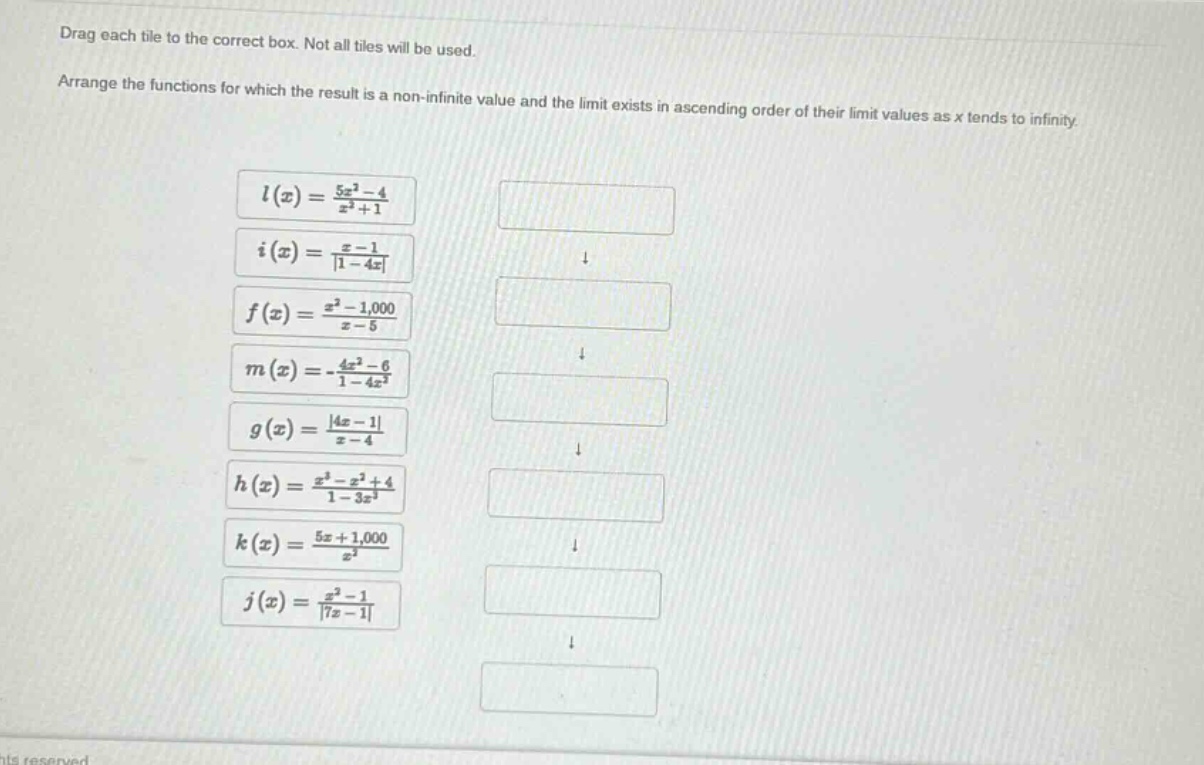
drag each tile to the correct box. not all tiles will be used. arrange the functions for which the result is a non - infinite value and the limit exists in ascending order of their limit values as x tends to infinity.\n$l(x)=\frac{5x^{2}-4}{x^{2}+1}$\n$i(x)=\frac{x - 1}{|1 - 4x|}$\n$f(x)=\frac{x^{2}-1000}{x - 5}$\n$m(x)=-\frac{4x^{2}-6}{1 - 4x^{2}}$\n$g(x)=\frac{|4x - 1|}{x - 4}$\n$h(x)=\frac{x^{3}-x^{2}+4}{1 - 3x^{3}}$\n$k(x)=\frac{5x + 1000}{x^{2}}$\n$j(x)=\frac{x^{2}-1}{|7x - 1|}$
Answer
Explanation:
Step1: Recall limit - rules for rational functions
For a rational function $y=\frac{a_nx^n + a_{n - 1}x^{n - 1}+\cdots+a_0}{b_mx^m + b_{m - 1}x^{m - 1}+\cdots+b_0}$, if $n=m$, $\lim_{x\rightarrow\infty}y=\frac{a_n}{b_m}$; if $n\lt m$, $\lim_{x\rightarrow\infty}y = 0$; if $n>m$, $\lim_{x\rightarrow\infty}y=\pm\infty$. For absolute - value functions, we consider the cases when $x$ is large.
Step2: Calculate $\lim_{x\rightarrow\infty}l(x)$
$l(x)=\frac{5x^2-4}{x^2 + 1}$, since the degrees of the numerator and denominator are the same ($n = m=2$), $\lim_{x\rightarrow\infty}l(x)=\lim_{x\rightarrow\infty}\frac{5x^2/x^2-4/x^2}{x^2/x^2 + 1/x^2}=\lim_{x\rightarrow\infty}\frac{5-\frac{4}{x^2}}{1+\frac{1}{x^2}} = 5$.
Step3: Calculate $\lim_{x\rightarrow\infty}i(x)$
$i(x)=\frac{x - 1}{|1 - 4x|}$. When $x\rightarrow\infty$, $|1 - 4x|=4x - 1$ (because for large $x$, $1-4x<0$). So $\lim_{x\rightarrow\infty}i(x)=\lim_{x\rightarrow\infty}\frac{x - 1}{4x - 1}=\lim_{x\rightarrow\infty}\frac{x/x-1/x}{4x/x - 1/x}=\frac{1 - 0}{4 - 0}=\frac{1}{4}$.
Step4: Calculate $\lim_{x\rightarrow\infty}f(x)$
$f(x)=\frac{x^2-1000}{x - 5}$, since the degree of the numerator ($n = 2$) is greater than the degree of the denominator ($m = 1$), $\lim_{x\rightarrow\infty}f(x)=\infty$, so we discard this function.
Step5: Calculate $\lim_{x\rightarrow\infty}m(x)$
$m(x)=-\frac{4x^2-6}{1 - 4x^2}$, since the degrees of the numerator and denominator are the same ($n = m = 2$), $\lim_{x\rightarrow\infty}m(x)=\lim_{x\rightarrow\infty}-\frac{4x^2/x^2-6/x^2}{1/x^2-4x^2/x^2}=\lim_{x\rightarrow\infty}-\frac{4-\frac{6}{x^2}}{\frac{1}{x^2}-4}=1$.
Step6: Calculate $\lim_{x\rightarrow\infty}g(x)$
$g(x)=\frac{|4x - 1|}{x - 4}$. When $x\rightarrow\infty$, $|4x - 1|=4x - 1$, so $\lim_{x\rightarrow\infty}g(x)=\lim_{x\rightarrow\infty}\frac{4x - 1}{x - 4}=\lim_{x\rightarrow\infty}\frac{4x/x-1/x}{x/x - 4/x}=4$.
Step7: Calculate $\lim_{x\rightarrow\infty}h(x)$
$h(x)=\frac{x^3-x^2 + 4}{1 - 3x^3}$, since the degrees of the numerator and denominator are the same ($n = m = 3$), $\lim_{x\rightarrow\infty}h(x)=\lim_{x\rightarrow\infty}\frac{x^3/x^3-x^2/x^3 + 4/x^3}{1/x^3-3x^3/x^3}=\lim_{x\rightarrow\infty}\frac{1-\frac{1}{x}+\frac{4}{x^3}}{\frac{1}{x^3}-3}=-\frac{1}{3}$.
Step8: Calculate $\lim_{x\rightarrow\infty}k(x)$
$k(x)=\frac{5x + 1000}{x^2}$, since the degree of the numerator ($n = 1$) is less than the degree of the denominator ($m = 2$), $\lim_{x\rightarrow\infty}k(x)=\lim_{x\rightarrow\infty}\frac{5x/x^2+1000/x^2}{x^2/x^2}=\lim_{x\rightarrow\infty}\frac{\frac{5}{x}+\frac{1000}{x^2}}{1}=0$.
Step9: Calculate $\lim_{x\rightarrow\infty}j(x)$
$j(x)=\frac{x^2-1}{|7x - 1|}$. When $x\rightarrow\infty$, $|7x - 1|=7x - 1$, and since the degree of the numerator ($n = 2$) is greater than the degree of the denominator ($m = 1$), $\lim_{x\rightarrow\infty}j(x)=\infty$, so we discard this function.
Step10: Arrange the functions in ascending order of their limits
The functions with non - infinite limits are $k(x),h(x),i(x),m(x),g(x),l(x)$. The limits are $\lim_{x\rightarrow\infty}k(x)=0$, $\lim_{x\rightarrow\infty}h(x)=-\frac{1}{3}$, $\lim_{x\rightarrow\infty}i(x)=\frac{1}{4}$, $\lim_{x\rightarrow\infty}m(x)=1$, $\lim_{x\rightarrow\infty}g(x)=4$, $\lim_{x\rightarrow\infty}l(x)=5$. The ascending order is $h(x),k(x),i(x),m(x),g(x),l(x)$.
Answer:
$h(x),k(x),i(x),m(x),g(x),l(x)$