drag the tiles to the correct boxes to complete the pairs. match each transformation with its description…
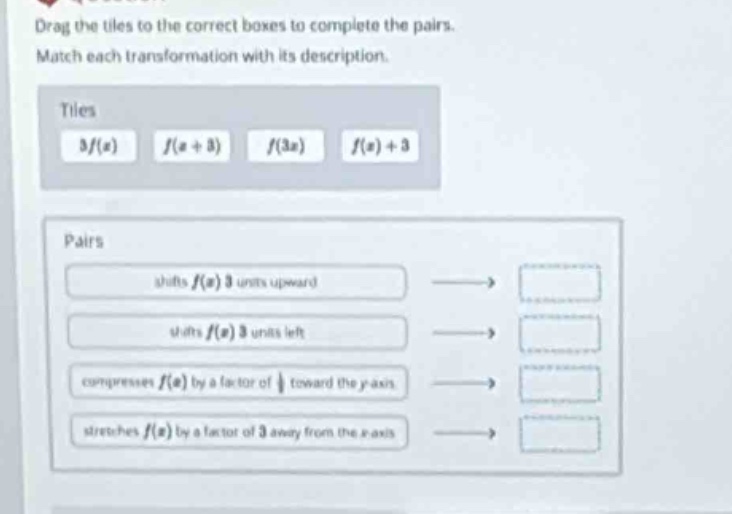
drag the tiles to the correct boxes to complete the pairs. match each transformation with its description. tiles 3f(x) f(x + 3) f(3x) f(x)+3 pairs shifts f(x) 3 units upward shifts f(x) 3 units left compresses f(x) by a factor of ⅓ toward the y - axis stretches f(x) by a factor of 3 away from the x - axis
Answer
Explanation:
Step1: Analyze vertical shift
For a function (y = f(x)), adding a constant (c) to the function (y=f(x)+c) shifts the graph of the function (c) units upward. When (c = 3), (y=f(x)+3) shifts (f(x)) 3 units upward.
Step2: Analyze horizontal shift
For a function (y = f(x)), replacing (x) with (x + h) shifts the graph of the function (h) units to the left. When (h=3), (y = f(x + 3)) shifts (f(x)) 3 units to the left.
Step3: Analyze horizontal compression
For a function (y = f(x)), replacing (x) with (ax) ((a>1)) compresses the graph of the function horizontally. When (a = 3), (y=f(3x)) compresses (f(x)) by a factor of (\frac{1}{3}) toward the (y -)axis.
Step4: Analyze vertical stretch
For a function (y = f(x)), multiplying the function by a constant (a>1) stretches the graph of the function vertically. When (a = 3), (y = 3f(x)) stretches (f(x)) by a factor of 3 away from the (x -)axis.
Answer:
- shifts (f(x)) 3 units upward: (f(x)+3)
- shifts (f(x)) 3 units left: (f(x + 3))
- compresses (f(x)) by a factor of (\frac{1}{3}) toward the (y -)axis: (f(3x))
- stretches (f(x)) by a factor of 3 away from the (x -)axis: (3f(x))