drag the tiles to the correct boxes to complete the pairs. not all tiles will be used. consider the graph of…
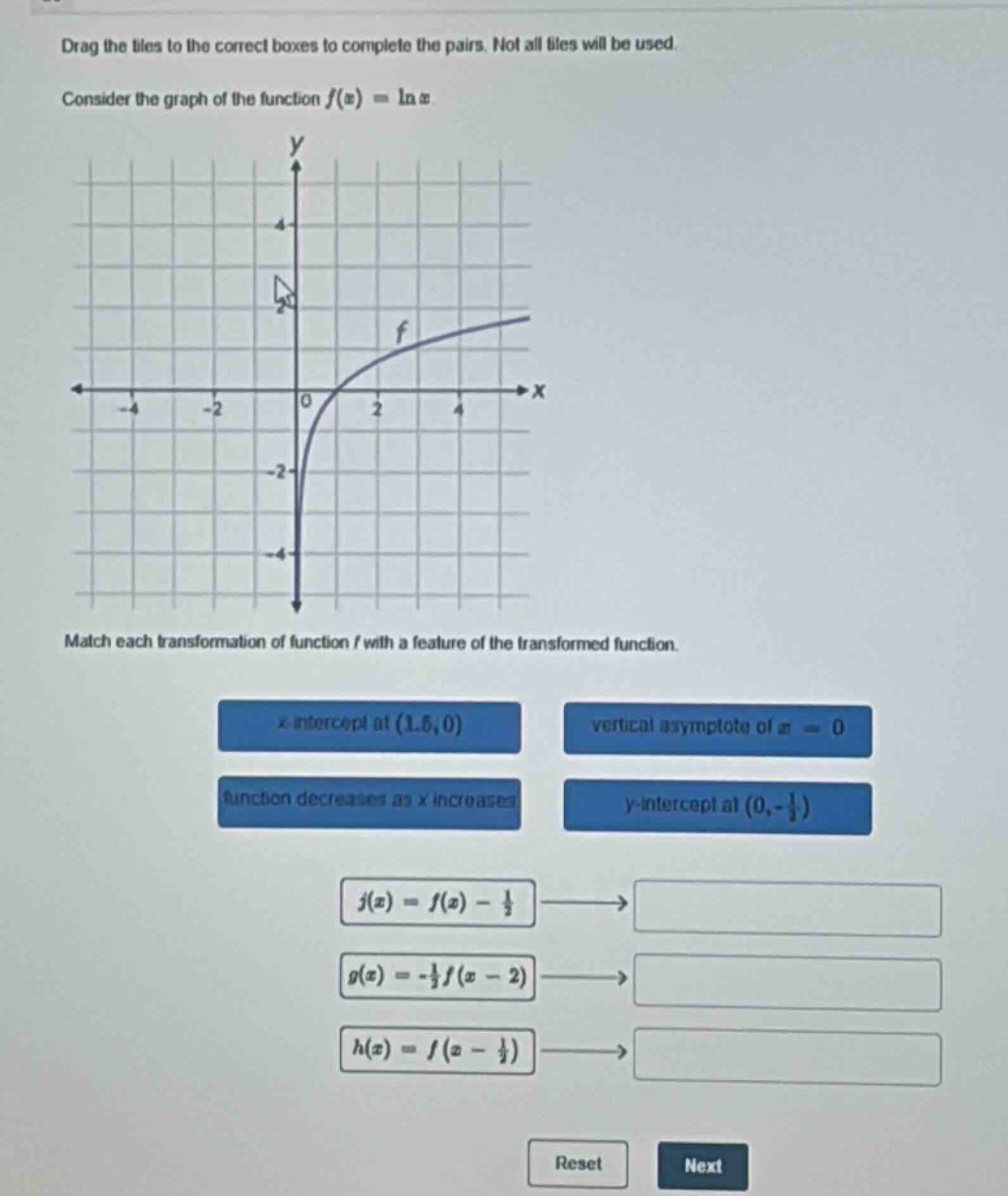
drag the tiles to the correct boxes to complete the pairs. not all tiles will be used. consider the graph of the function f(x)=ln x. match each transformation of function f with a feature of the transformed function. x - intercept at (1.5,0) vertical asymptote of x = 0 function decreases as x increases y - intercept at (0,-1/2) j(x)=f(x)-1/2 g(x)=-1/2f(x - 2) h(x)=f(x - 1/2)
Answer
Answer:
- $j(x)=f(x)-\frac{1}{2}$: $y - intercept\ at\ (0,-\frac{1}{2})$
- $g(x)=-\frac{1}{2}f(x - 2)$: $function\ decreases\ as\ x\ increases$
- $h(x)=f(x-\frac{1}{2})$: $x - intercept\ at\ (1.5,0)$
Explanation:
Step1: Analyze $j(x)=f(x)-\frac{1}{2}$
The original function $y = f(x)=\ln x$ has $y$-intercept undefined. For $j(x)=\ln x-\frac{1}{2}$, when $x = 1$, $j(1)=\ln(1)-\frac{1}{2}=0 - \frac{1}{2}=-\frac{1}{2}$. So the $y$-intercept is $(0,-\frac{1}{2})$.
Step2: Analyze $g(x)=-\frac{1}{2}f(x - 2)$
The original function $y = f(x)=\ln x$ is an increasing function. For $g(x)=-\frac{1}{2}\ln(x - 2)$, the negative - sign in front of the function and the horizontal shift do not change the fact that the function is decreasing as $x$ increases due to the negative coefficient.
Step3: Analyze $h(x)=f(x-\frac{1}{2})$
The original function $y = f(x)=\ln x$ has an $x$-intercept at $(1,0)$. For $h(x)=\ln(x-\frac{1}{2})$, when $y = 0$, $\ln(x-\frac{1}{2})=0$. Since $\ln1 = 0$, then $x-\frac{1}{2}=1$, and $x = 1.5$. So the $x$-intercept is $(1.5,0)$.