draw the graph of $f(x)=-\\left(\\frac{1}{3}\\right)^{x - 2}$
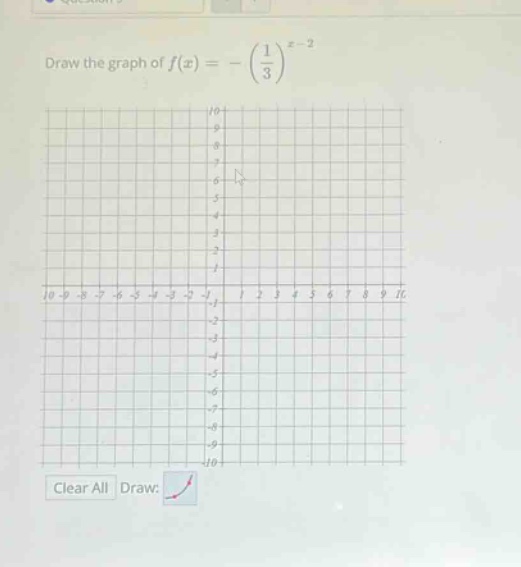
draw the graph of $f(x)=-\\left(\\frac{1}{3}\\right)^{x - 2}$
Answer
Explanation:
Step1: Analyze the general form of exponential - function
The function is of the form $y = -a^{x - h}$, where $a=\frac{1}{3}$ and $h = 2$. The general form of an exponential function is $y=a^{x}$ ($a>0,a\neq1$). When $0 < a<1$, the function $y = a^{x}$ is a decreasing function. For $y=-a^{x - h}$, it is a reflection of $y = a^{x - h}$ about the $x$ - axis.
Step2: Find the $y$ - intercept
To find the $y$ - intercept, set $x = 0$. Then $y=-\left(\frac{1}{3}\right)^{0 - 2}=-\left(\frac{1}{3}\right)^{-2}=-9$.
Step3: Find the horizontal asymptote
For an exponential function of the form $y=-a^{x - h}+k$ (in this case $k = 0$), the horizontal asymptote is $y = 0$.
Step4: Plot key points and draw the graph
We know the $y$ - intercept is $(0,-9)$. As $x\rightarrow+\infty$, $y\rightarrow0$ (from below since it is a negative - valued exponential function). As $x\rightarrow-\infty$, $y\rightarrow-\infty$. Plot the point $(0, - 9)$ and use the behavior of the function (decreasing and approaching the horizontal asymptote $y = 0$) to draw a smooth curve.
Answer:
Plot the point $(0,-9)$, note the horizontal asymptote $y = 0$, and draw a decreasing curve approaching the asymptote as $x$ increases and going to negative infinity as $x$ decreases.