f(x)=∫₀^√x t²dt\nf(x)=□
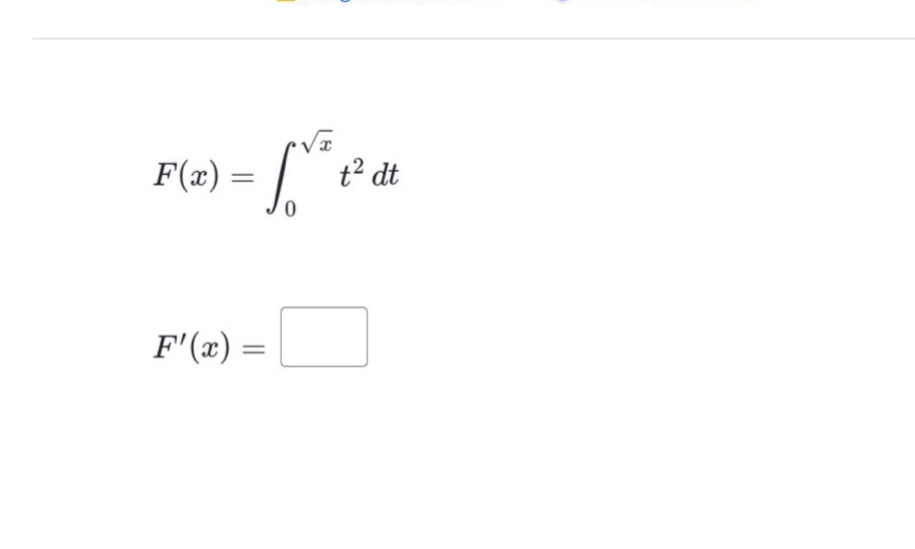
f(x)=∫₀^√x t²dt\nf(x)=□
Answer
Explanation:
Step1: Apply the fundamental theorem of calculus and chain - rule
Let $u = \sqrt{x}$, then $F(x)=\int_{0}^{u}t^{2}dt$. By the fundamental theorem of calculus, if $G(u)=\int_{0}^{u}t^{2}dt$, then $G^\prime(u)=u^{2}$. And by the chain - rule, $F^\prime(x)=G^\prime(u)\cdot u^\prime$.
Step2: Find the derivative of $u = \sqrt{x}$
We know that if $u = \sqrt{x}=x^{\frac{1}{2}}$, then $u^\prime=\frac{1}{2}x^{-\frac{1}{2}}$ according to the power - rule $(x^{n})^\prime=nx^{n - 1}$.
Step3: Substitute $u$ and $u^\prime$ into the chain - rule formula
Since $G^\prime(u)=u^{2}$ and $u = \sqrt{x}$, then $G^\prime(u)=x$. And $u^\prime=\frac{1}{2}x^{-\frac{1}{2}}$. So $F^\prime(x)=x\cdot\frac{1}{2}x^{-\frac{1}{2}}$.
Step4: Simplify the expression
Using the rule of exponents $a^{m}\cdot a^{n}=a^{m + n}$, we have $F^\prime(x)=\frac{1}{2}x^{1-\frac{1}{2}}=\frac{1}{2}\sqrt{x}$.
Answer:
$\frac{1}{2}\sqrt{x}$