3. ∫-2,1 (x² + x)/x dx (a) 3 (b) 3/2 (c) 2 (d) non existent
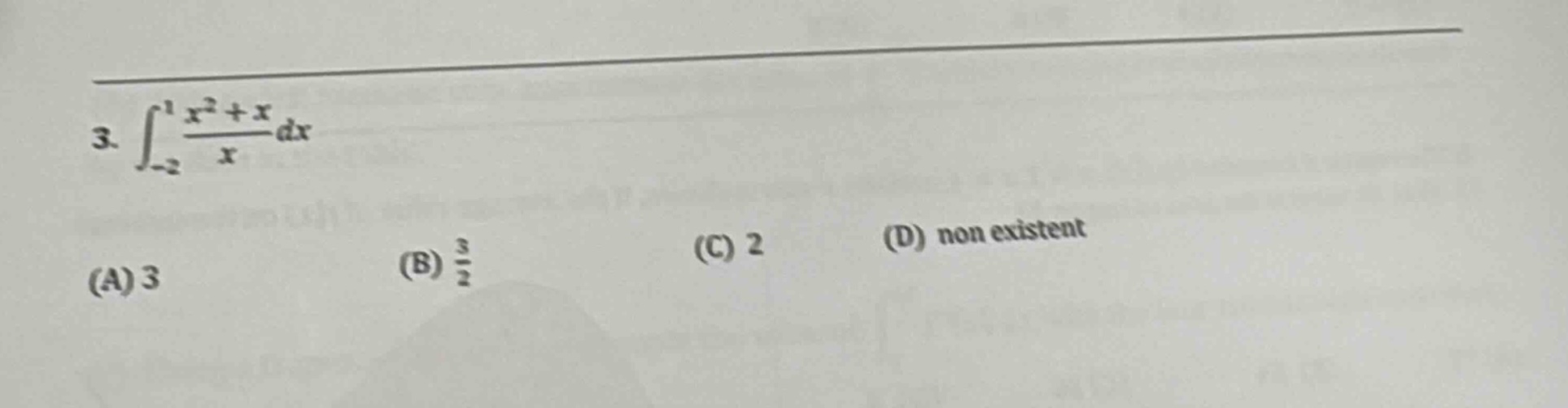
3. ∫-2,1 (x² + x)/x dx (a) 3 (b) 3/2 (c) 2 (d) non existent
Answer
Explanation:
Step1: Simplify the integrand
First, simplify $\frac{x^{2}+x}{x}$ to $x + 1$ for $x\neq0$. The integral becomes $\int_{-2}^{1}(x + 1)dx$. But the function $y=\frac{x^{2}+x}{x}$ has a discontinuity at $x = 0$ in the interval $[-2,1]$. So we split the integral into two improper - integrals: $\int_{-2}^{0}\frac{x^{2}+x}{x}dx+\int_{0}^{1}\frac{x^{2}+x}{x}dx=\int_{-2}^{0}(x + 1)dx+\int_{0}^{1}(x + 1)dx$.
Step2: Calculate the first improper - integral
For $\int_{-2}^{0}(x + 1)dx=\lim_{a\rightarrow0^{-}}\int_{-2}^{a}(x + 1)dx$. Using the power - rule of integration $\int(x + 1)dx=\frac{x^{2}}{2}+x+C$. Then $\lim_{a\rightarrow0^{-}}\left[\frac{x^{2}}{2}+x\right]{-2}^{a}=\lim{a\rightarrow0^{-}}\left(\frac{a^{2}}{2}+a-\left(\frac{(-2)^{2}}{2}-2\right)\right)=\lim_{a\rightarrow0^{-}}\left(\frac{a^{2}}{2}+a-(2 - 2)\right)=\lim_{a\rightarrow0^{-}}\left(\frac{a^{2}}{2}+a\right)=0$.
Step3: Calculate the second improper - integral
For $\int_{0}^{1}(x + 1)dx=\lim_{b\rightarrow0^{+}}\int_{b}^{1}(x + 1)dx$. Using the power - rule of integration $\int(x + 1)dx=\frac{x^{2}}{2}+x+C$. Then $\lim_{b\rightarrow0^{+}}\left[\frac{x^{2}}{2}+x\right]{b}^{1}=\lim{b\rightarrow0^{+}}\left(\frac{1^{2}}{2}+1-\left(\frac{b^{2}}{2}+b\right)\right)=\frac{1}{2}+1=\frac{3}{2}$.
Step4: Combine the results
The original integral $\int_{-2}^{1}\frac{x^{2}+x}{x}dx$ is the sum of the two improper - integrals. $\int_{-2}^{1}\frac{x^{2}+x}{x}dx=\int_{-2}^{0}(x + 1)dx+\int_{0}^{1}(x + 1)dx=0+\frac{3}{2}=\frac{3}{2}$.
Answer:
B. $\frac{3}{2}$