dy/dx = y^4 and y(2) = -1. y(-1) =
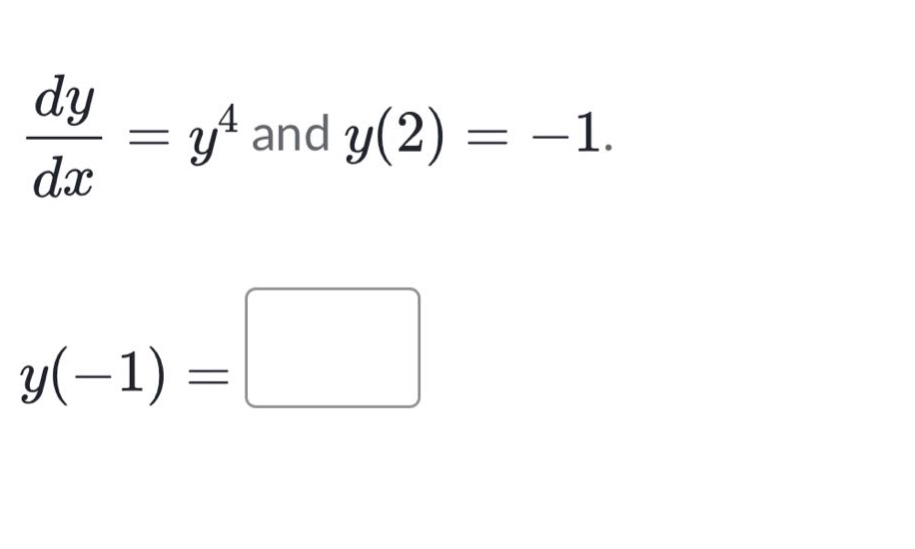
dy/dx = y^4 and y(2) = -1. y(-1) =
Answer
Explanation:
Step1: Separate variables
Separate the variables in the differential - equation $\frac{dy}{dx}=y^{4}$. We get $\frac{dy}{y^{4}} = dx$.
Step2: Integrate both sides
Integrate $\int y^{-4}dy=\int dx$. Using the power - rule for integration $\int x^{n}dx=\frac{x^{n + 1}}{n+1}+C$ ($n\neq - 1$), we have $\frac{y^{-4 + 1}}{-4 + 1}=x + C$, which simplifies to $-\frac{1}{3y^{3}}=x + C$.
Step3: Use the initial condition
We know that $y(2)=-1$. Substitute $x = 2$ and $y=-1$ into $-\frac{1}{3y^{3}}=x + C$. Then $-\frac{1}{3(-1)^{3}}=2 + C$. Simplify the left - hand side: $\frac{1}{3}=2 + C$, so $C=\frac{1}{3}-2=-\frac{5}{3}$.
Step4: Find the particular solution
The particular solution is $-\frac{1}{3y^{3}}=x-\frac{5}{3}$.
Step5: Solve for $y(-1)$
Substitute $x=-1$ into $-\frac{1}{3y^{3}}=x-\frac{5}{3}$. We get $-\frac{1}{3y^{3}}=-1-\frac{5}{3}=-\frac{3 + 5}{3}=-\frac{8}{3}$. Cross - multiply to get $1 = 8y^{3}$, then $y^{3}=\frac{1}{8}$, and $y=\frac{1}{2}$.
Answer:
$\frac{1}{2}$