dy/dx=-xe^(-x^2)/y which curve solves the differential equation and passes through the point (0,1)? choose 1…
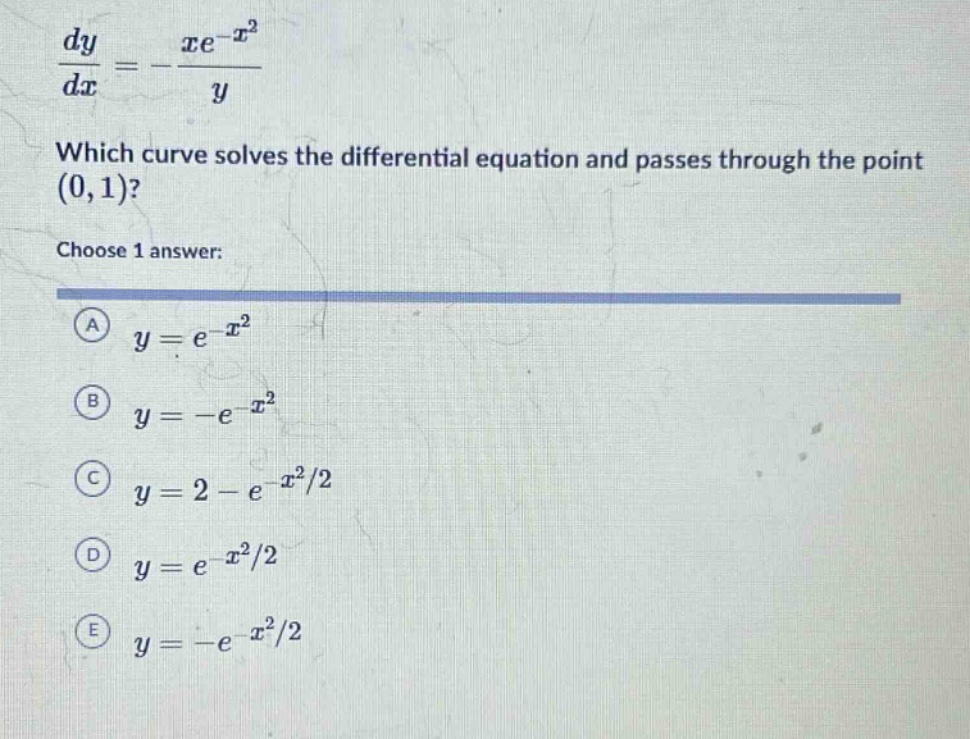
dy/dx=-xe^(-x^2)/y which curve solves the differential equation and passes through the point (0,1)? choose 1 answer: a y = e^(-x^2) b y = -e^(-x^2) c y = 2 - e^(-x^2/2) d y = e^(-x^2/2) e y = -e^(-x^2/2)
Answer
Explanation:
Step1: Separate variables
Separate the variables in the differential equation $\frac{dy}{dx}=-\frac{xe^{-x^{2}}}{y}$. We get $y;dy=-xe^{-x^{2}}dx$.
Step2: Integrate both sides
Integrate $\int y;dy=\int -xe^{-x^{2}}dx$. For the left - hand side, $\int y;dy=\frac{y^{2}}{2}+C_1$. For the right - hand side, let $u = - x^{2}$, then $du=-2x;dx$ and $x;dx=-\frac{1}{2}du$. So $\int -xe^{-x^{2}}dx=\frac{1}{2}\int e^{u}du=\frac{1}{2}e^{u}+C_2=\frac{1}{2}e^{-x^{2}}+C_2$. Then $\frac{y^{2}}{2}=\frac{1}{2}e^{-x^{2}}+C$.
Step3: Use the initial condition
The curve passes through the point $(0,1)$. Substitute $x = 0$ and $y = 1$ into $\frac{y^{2}}{2}=\frac{1}{2}e^{-x^{2}}+C$. We have $\frac{1^{2}}{2}=\frac{1}{2}e^{0}+C$, which simplifies to $\frac{1}{2}=\frac{1}{2}+C$, so $C = 0$. Then $y^{2}=e^{-x^{2}}$, and since $y(0)=1>0$, $y = e^{-\frac{x^{2}}{2}}$.
Answer:
D. $y = e^{-x^{2}/2}$