dy/dx = √(xy)\nwhich curve solves the differential equation and passes through the point (0,9)?\nchoose 1…
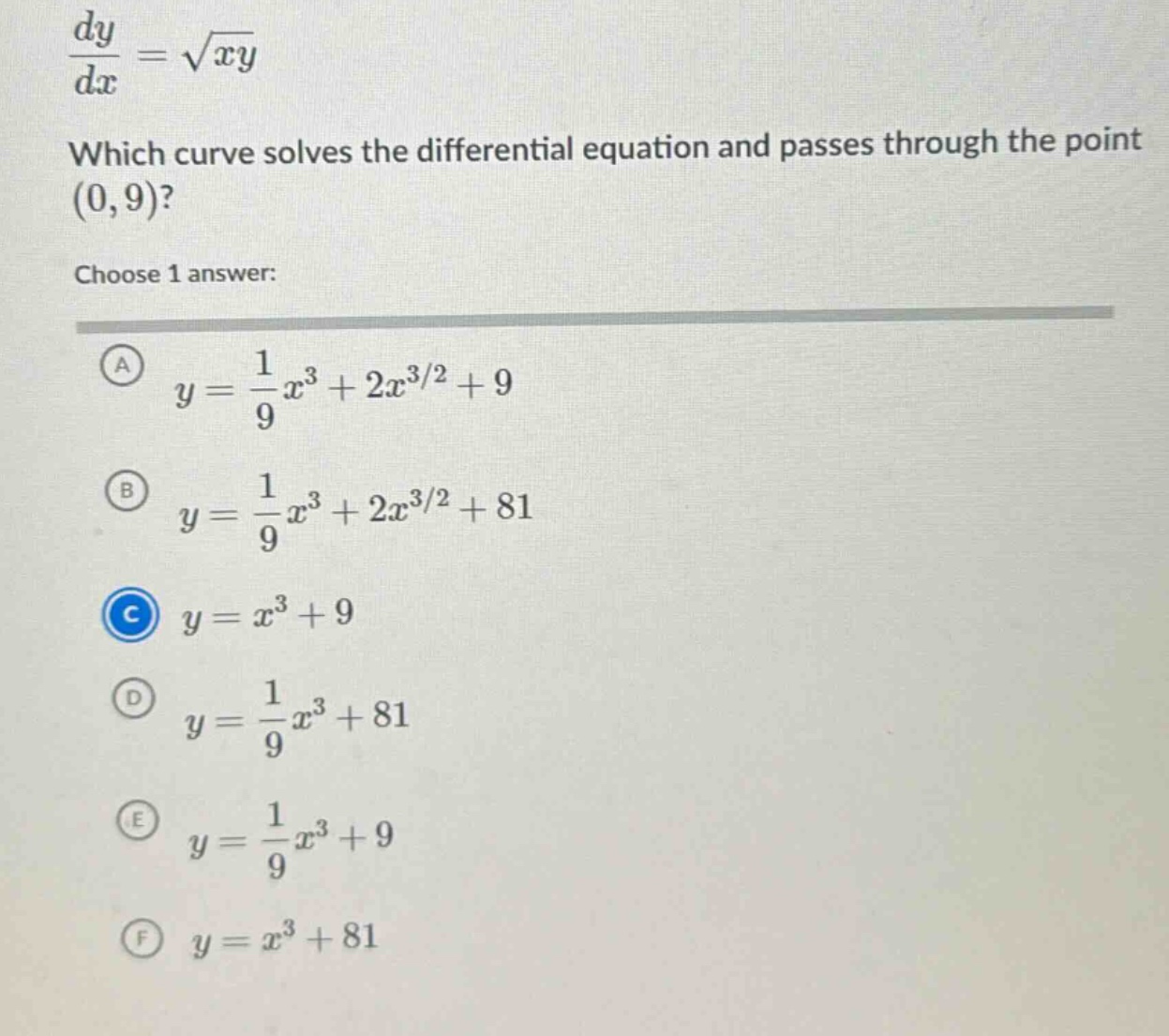
dy/dx = √(xy)\nwhich curve solves the differential equation and passes through the point (0,9)?\nchoose 1 answer:\na y = 1/9 x³ + 2x³/² + 9\nb y = 1/9 x³ + 2x³/² + 81\nc y = x³ + 9\nd y = 1/9 x³ + 81\ne y = 1/9 x³ + 9\nf y = x³ + 81
Answer
Explanation:
Step1: Separate variables
Separate the variables in the differential equation $\frac{dy}{dx}=\sqrt{xy}$. We get $\frac{dy}{\sqrt{y}}=\sqrt{x}dx$.
Step2: Integrate both sides
Integrate $\int y^{-\frac{1}{2}}dy=\int x^{\frac{1}{2}}dx$. Using the power - rule for integration $\int x^{n}dx=\frac{x^{n + 1}}{n+1}+C$ ($n\neq - 1$), we have $2y^{\frac{1}{2}}=\frac{2}{3}x^{\frac{3}{2}}+C$.
Step3: Use the initial condition
The curve passes through the point $(0,9)$. Substitute $x = 0$ and $y=9$ into $2y^{\frac{1}{2}}=\frac{2}{3}x^{\frac{3}{2}}+C$. Then $2\sqrt{9}=\frac{2}{3}(0)^{\frac{3}{2}}+C$, so $C = 6$.
Step4: Solve for y
From $2y^{\frac{1}{2}}=\frac{2}{3}x^{\frac{3}{2}}+6$, we first divide both sides by 2 to get $y^{\frac{1}{2}}=\frac{1}{3}x^{\frac{3}{2}} + 3$. Then square both sides: $y=\left(\frac{1}{3}x^{\frac{3}{2}}+3\right)^{2}=\frac{1}{9}x^{3}+2x^{\frac{3}{2}} + 9$.
Answer:
A. $y=\frac{1}{9}x^{3}+2x^{3/2}+9$