ections: evaluate the following expressions without a calculator. 1. $cos^{-1}(\frac{1}{2})$ 2…
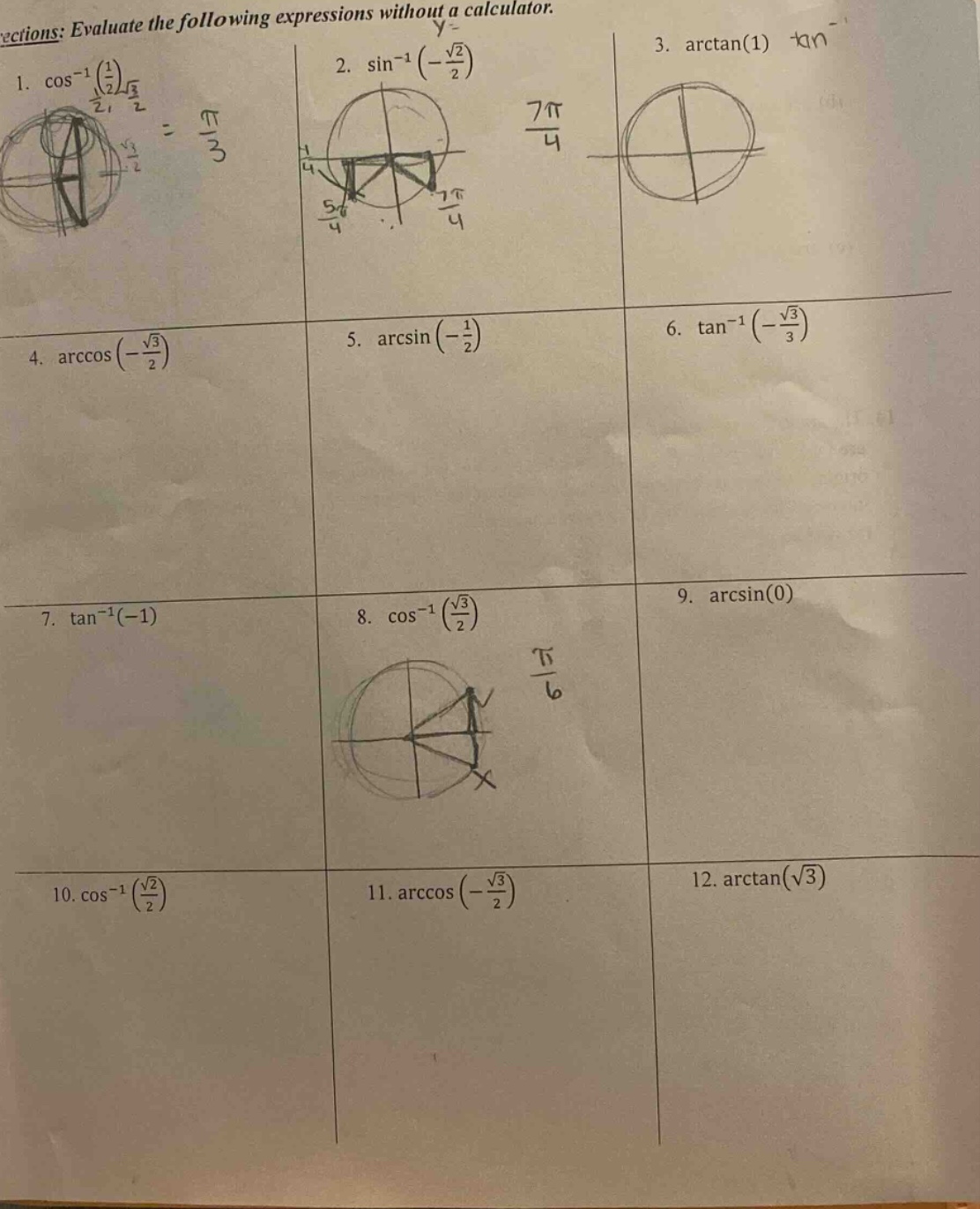
ections: evaluate the following expressions without a calculator. 1. $cos^{-1}(\frac{1}{2})$ 2. $sin^{-1}(-\frac{sqrt{2}}{2})$ 3. $arctan(1)$ 4. $arccos(-\frac{sqrt{3}}{2})$ 5. $arcsin(-\frac{1}{2})$ 6. $\tan^{-1}(-\frac{sqrt{3}}{3})$ 7. $\tan^{-1}(-1)$ 8. $cos^{-1}(\frac{sqrt{3}}{2})$ 9. $arcsin(0)$ 10. $cos^{-1}(\frac{sqrt{2}}{2})$ 11. $arccos(-\frac{sqrt{3}}{2})$ 12. $arctan(sqrt{3})$
Answer
Explanation:
Step1: Recall inverse - cosine range
The range of (y = \cos^{-1}(x)) is ([0,\pi]). We know that (\cos(\frac{\pi}{3})=\frac{1}{2}), so (\cos^{-1}(\frac{1}{2})=\frac{\pi}{3}).
Step2: Recall inverse - sine range
The range of (y=\sin^{-1}(x)) is ([-\frac{\pi}{2},\frac{\pi}{2}]). Since (\sin(-\frac{\pi}{4}) =-\frac{\sqrt{2}}{2}), then (\sin^{-1}(-\frac{\sqrt{2}}{2})=-\frac{\pi}{4}).
Step3: Recall inverse - tangent range
The range of (y = \tan^{-1}(x)) is ((-\frac{\pi}{2},\frac{\pi}{2})). As (\tan(\frac{\pi}{4}) = 1), so (\arctan(1)=\frac{\pi}{4}).
Step4: For (\arccos(-\frac{\sqrt{3}}{2}))
Since the range of (y=\cos^{-1}(x)) is ([0,\pi]) and (\cos(\frac{5\pi}{6})=-\frac{\sqrt{3}}{2}), then (\arccos(-\frac{\sqrt{3}}{2})=\frac{5\pi}{6}).
Step5: For (\arcsin(-\frac{1}{2}))
With the range of (y = \sin^{-1}(x)) being ([-\frac{\pi}{2},\frac{\pi}{2}]) and (\sin(-\frac{\pi}{6})=-\frac{1}{2}), we have (\arcsin(-\frac{1}{2})=-\frac{\pi}{6}).
Step6: For (\tan^{-1}(-\frac{\sqrt{3}}{3}))
Given the range of (y=\tan^{-1}(x)) is ((-\frac{\pi}{2},\frac{\pi}{2})) and (\tan(-\frac{\pi}{6})=-\frac{\sqrt{3}}{3}), so (\tan^{-1}(-\frac{\sqrt{3}}{3})=-\frac{\pi}{6}).
Step7: For (\tan^{-1}(-1))
Since the range of (y = \tan^{-1}(x)) is ((-\frac{\pi}{2},\frac{\pi}{2})) and (\tan(-\frac{\pi}{4})=-1), then (\tan^{-1}(-1)=-\frac{\pi}{4}).
Step8: For (\cos^{-1}(\frac{\sqrt{3}}{2}))
As the range of (y=\cos^{-1}(x)) is ([0,\pi]) and (\cos(\frac{\pi}{6})=\frac{\sqrt{3}}{2}), we get (\cos^{-1}(\frac{\sqrt{3}}{2})=\frac{\pi}{6}).
Step9: For (\arcsin(0))
With the range of (y = \sin^{-1}(x)) being ([-\frac{\pi}{2},\frac{\pi}{2}]) and (\sin(0) = 0), so (\arcsin(0)=0).
Step10: For (\cos^{-1}(\frac{\sqrt{2}}{2}))
Since the range of (y=\cos^{-1}(x)) is ([0,\pi]) and (\cos(\frac{\pi}{4})=\frac{\sqrt{2}}{2}), then (\cos^{-1}(\frac{\sqrt{2}}{2})=\frac{\pi}{4}).
Step11: For (\arccos(-\frac{\sqrt{3}}{2})) (again)
The range of (y=\cos^{-1}(x)) is ([0,\pi]) and (\cos(\frac{5\pi}{6})=-\frac{\sqrt{3}}{2}), so (\arccos(-\frac{\sqrt{3}}{2})=\frac{5\pi}{6}).
Step12: For (\arctan(\sqrt{3}))
Given the range of (y=\tan^{-1}(x)) is ((-\frac{\pi}{2},\frac{\pi}{2})) and (\tan(\frac{\pi}{3})=\sqrt{3}), so (\arctan(\sqrt{3})=\frac{\pi}{3}).
Answer:
- (\frac{\pi}{3})
- (-\frac{\pi}{4})
- (\frac{\pi}{4})
- (\frac{5\pi}{6})
- (-\frac{\pi}{6})
- (-\frac{\pi}{6})
- (-\frac{\pi}{4})
- (\frac{\pi}{6})
- (0)
- (\frac{\pi}{4})
- (\frac{5\pi}{6})
- (\frac{\pi}{3})