what is the effect of replacing f(x) with f(x - 3)?\na. the range of f(x - 3) is the same as the range of…
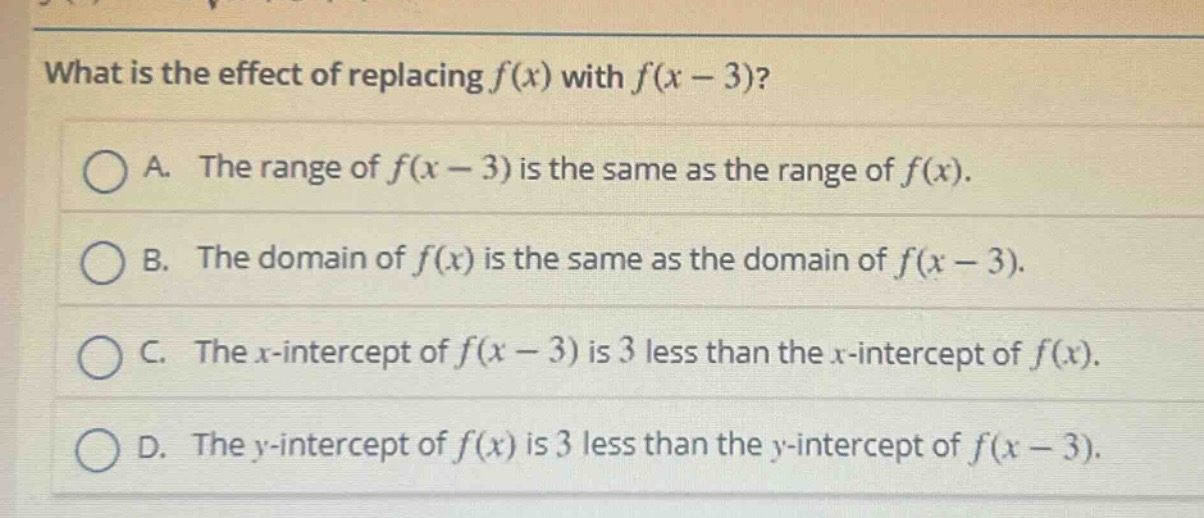
what is the effect of replacing f(x) with f(x - 3)?\na. the range of f(x - 3) is the same as the range of f(x).\nb. the domain of f(x) is the same as the domain of f(x - 3).\nc. the x - intercept of f(x - 3) is 3 less than the x - intercept of f(x).\nd. the y - intercept of f(x) is 3 less than the y - intercept of f(x - 3).
Answer
Answer:
A. The range of $f(x - 3)$ is the same as the range of $f(x)$.
Explanation:
Step1: Recall function - transformation rule
Replacing $x$ with $x - h$ in $y = f(x)$ gives $y=f(x - h)$, which is a horizontal shift.
Step2: Analyze domain - change
For $y = f(x)$ and $y = f(x - 3)$, the domain of $f(x-3)$ is obtained by solving $x-3\in D_f$ (where $D_f$ is the domain of $f(x)$). So the domain of $f(x - 3)$ is the domain of $f(x)$ shifted 3 units to the right, not the same.
Step3: Analyze range - change
A horizontal shift does not change the set of output values. So the range of $f(x - 3)$ is the same as the range of $f(x)$.
Step4: Analyze x - intercept change
Let the $x$-intercept of $f(x)$ be $x_0$ such that $f(x_0)=0$. For $f(x - 3)$, we set $f(x - 3)=0$, then $x-3=x_0$ or $x=x_0 + 3$. So the $x$-intercept of $f(x - 3)$ is 3 more than the $x$-intercept of $f(x)$.
Step5: Analyze y - intercept change
The $y$-intercept of $f(x)$ is $f(0)$, and the $y$-intercept of $f(x - 3)$ is $f(- 3)$. There is no such relation that the $y$-intercept of $f(x)$ is 3 less than the $y$-intercept of $f(x - 3)$.