ejercicio 5. 1. si f una función cuya fórmula es: $f(x)=\begin{cases}ax^{2}+b& \text{si }x > 2\\-b + 1&…
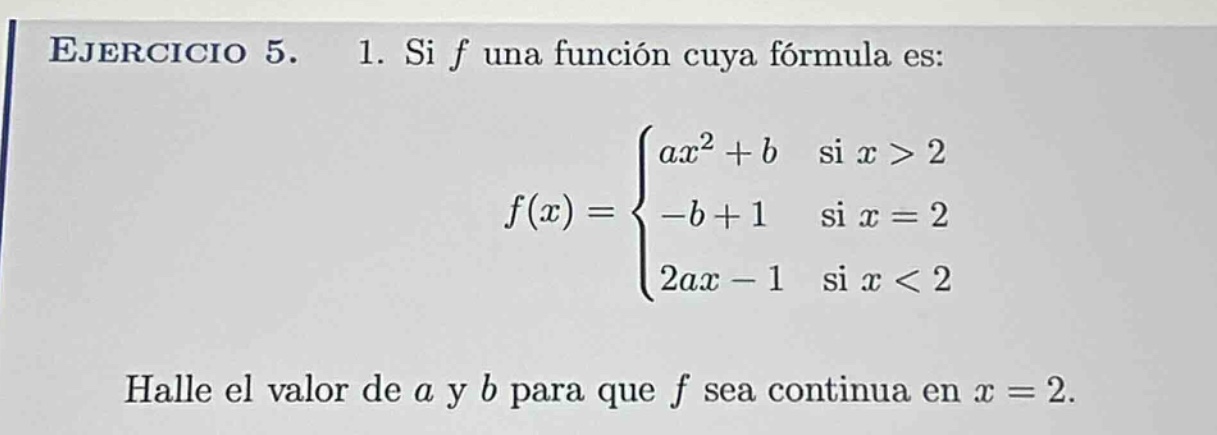
ejercicio 5. 1. si f una función cuya fórmula es: $f(x)=\begin{cases}ax^{2}+b& \text{si }x > 2\\-b + 1& \text{si }x = 2\\2ax-1& \text{si }x < 2end{cases}$ halle el valor de a y b para que f sea continua en $x = 2$.
Answer
Explanation:
Step1: Recall continuity condition
For a function to be continuous at $x = c$, $\lim_{x\rightarrow c^{-}}f(x)=\lim_{x\rightarrow c^{+}}f(x)=f(c)$. Here $c = 2$, so $\lim_{x\rightarrow 2^{-}}f(x)=\lim_{x\rightarrow 2^{+}}f(x)=f(2)$.
Step2: Calculate left - hand limit
$\lim_{x\rightarrow 2^{-}}f(x)=\lim_{x\rightarrow 2^{-}}(2ax - 1)$. Substitute $x = 2$ into $2ax-1$, we get $4a-1$.
Step3: Calculate right - hand limit
$\lim_{x\rightarrow 2^{+}}f(x)=\lim_{x\rightarrow 2^{+}}(ax^{2}+b)$. Substitute $x = 2$ into $ax^{2}+b$, we get $4a + b$.
Step4: Evaluate function at $x = 2$
$f(2)=-b + 1$.
Step5: Set up equations
Since $\lim_{x\rightarrow 2^{-}}f(x)=f(2)$ and $\lim_{x\rightarrow 2^{+}}f(x)=f(2)$, we have the system of equations: $\begin{cases}4a-1=-b + 1\4a + b=-b + 1\end{cases}$ From the first equation $4a-1=-b + 1$, we can rewrite it as $4a+b=2$. The second equation is $4a + 2b=1$. Subtract the first new - formed equation from the second: $(4a + 2b)-(4a + b)=1 - 2$, which gives $b=-1$. Substitute $b=-1$ into $4a+b=2$, we have $4a-1=2$, then $4a=3$, so $a=\frac{3}{4}$.
Answer:
$a=\frac{3}{4}, b=-1$