end behavior of a power function\nidentify the end behaviors for the function graphed to the right\nright…
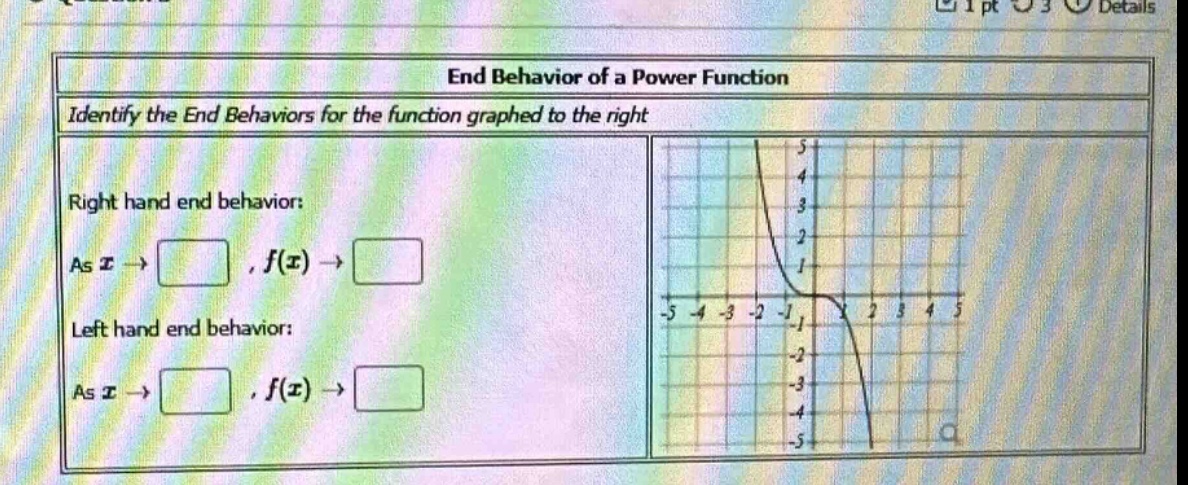
end behavior of a power function\nidentify the end behaviors for the function graphed to the right\nright hand end behavior:\nas (x\rightarrowsquare,f(x)\rightarrowsquare)\nleft hand end behavior:\nas (x\rightarrowsquare,f(x)\rightarrowsquare)
Answer
Explanation:
Step1: Analyze right - hand end behavior
As we move to the right on the x - axis (i.e., as (x\to+\infty)), we observe the y - values of the function. Looking at the graph, as (x) gets larger and larger (positive direction), the function values (f(x)) are getting more and more negative. So, as (x\to+\infty), (f(x)\to-\infty).
Step2: Analyze left - hand end behavior
As we move to the left on the x - axis (i.e., as (x\to-\infty)), we observe the y - values of the function. From the graph, as (x) gets more and more negative, the function values (f(x)) are getting more and more positive. So, as (x\to-\infty), (f(x)\to+\infty).
Answer:
Right hand end behavior: As (x\to+\infty), (f(x)\to-\infty) Left hand end behavior: As (x\to-\infty), (f(x)\to+\infty)