at the end of exercise 10.2.2, you were asked to use technology to sketch graphs of the form $f(x)=e^{(x +…
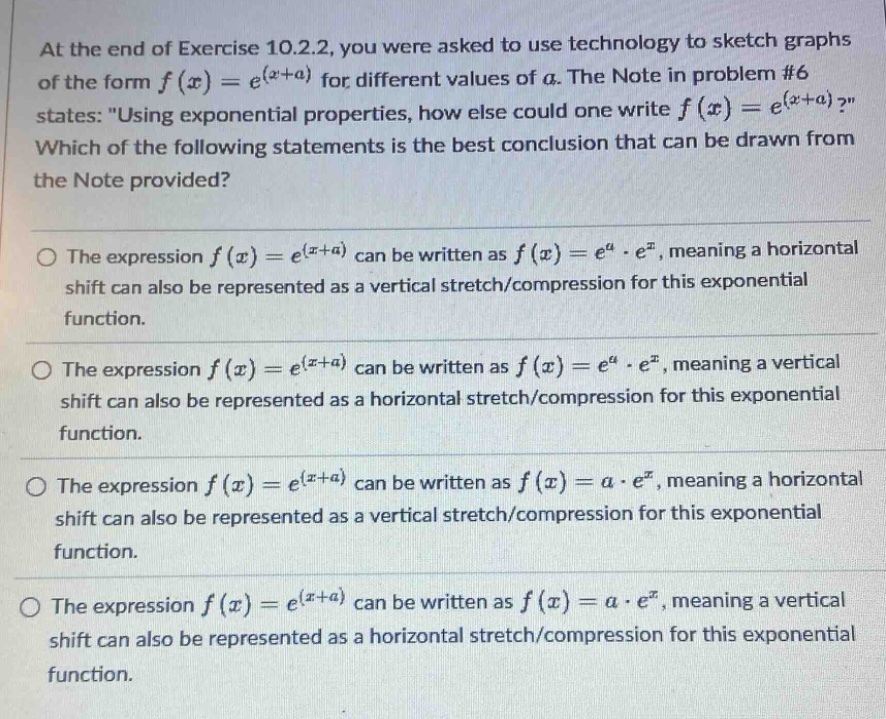
at the end of exercise 10.2.2, you were asked to use technology to sketch graphs of the form $f(x)=e^{(x + a)}$ for different values of $a$. the note in problem #6 states: \using exponential properties, how else could one write $f(x)=e^{(x + a)}$?\ which of the following statements is the best conclusion that can be drawn from the note provided?\n\nthe expression $f(x)=e^{(x + a)}$ can be written as $f(x)=e^{a}cdot e^{x}$, meaning a horizontal shift can also be represented as a vertical stretch/compression for this exponential function.\n\nthe expression $f(x)=e^{(x + a)}$ can be written as $f(x)=e^{a}cdot e^{x}$, meaning a vertical shift can also be represented as a horizontal stretch/compression for this exponential function.\n\nthe expression $f(x)=e^{(x + a)}$ can be written as $f(x)=acdot e^{x}$, meaning a horizontal shift can also be represented as a vertical stretch/compression for this exponential function.\n\nthe expression $f(x)=e^{(x + a)}$ can be written as $f(x)=acdot e^{x}$, meaning a vertical shift can also be represented as a horizontal stretch/compression for this exponential function.
Answer
Brief Explanations:
Using the exponential - property (e^{m + n}=e^{m}\cdot e^{n}), we have (e^{x + a}=e^{a}\cdot e^{x}). A horizontal shift of the function (y = e^{x}) by (a) units (left if (a>0) and right if (a < 0)) can be thought of as a vertical stretch or compression by a factor of (e^{a}) since (e^{a}) is a constant multiplier of (e^{x}).
Answer:
The expression (f(x)=e^{(x + a)}) can be written as (f(x)=e^{a}\cdot e^{x}), meaning a horizontal shift can also be represented as a vertical stretch/compression for this exponential function.