enter a t or an f in each answer space below to indicate whether the corresponding statement is true or…
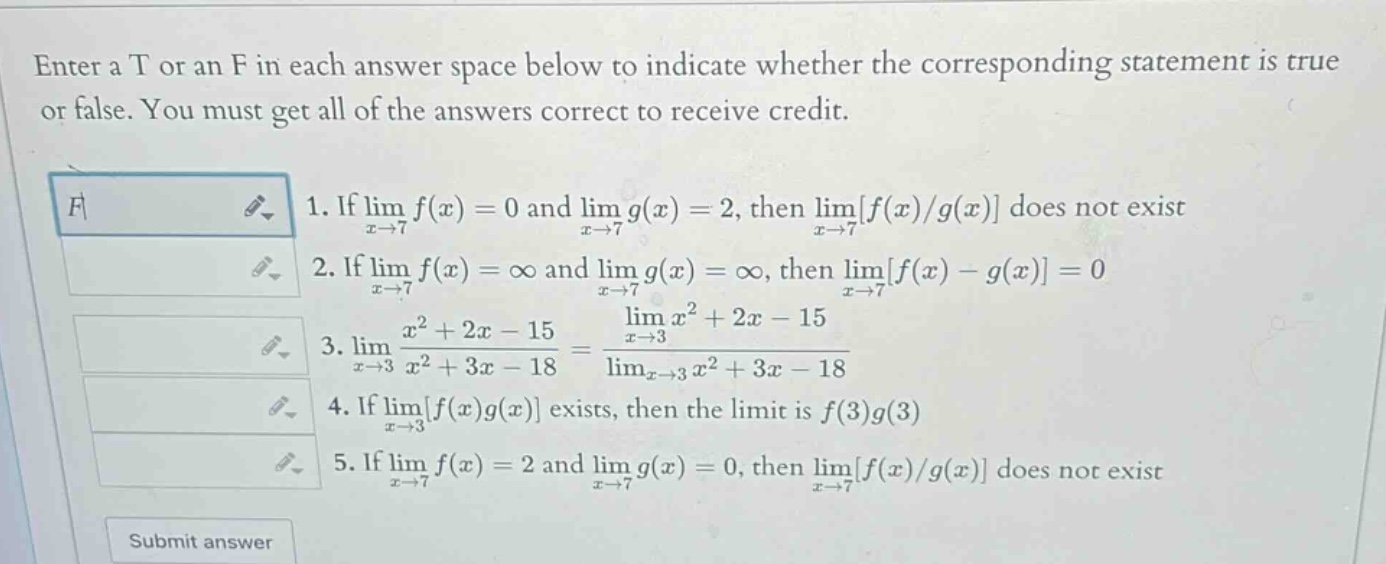
enter a t or an f in each answer space below to indicate whether the corresponding statement is true or false. you must get all of the answers correct to receive credit. 1. if lim x→7 f(x)=0 and lim x→7 g(x)=2, then lim x→7 f(x)/g(x) does not exist 2. if lim x→7 f(x)=∞ and lim x→7 g(x)=∞, then lim x→7 f(x)-g(x)=0 3. lim x→3 (x² + 2x - 15)/(x² + 3x - 18)=(lim x→3 x² + 2x - 15)/(lim x→3 x² + 3x - 18) 4. if lim x→3 f(x)g(x) exists, then the limit is f(3)g(3) 5. if lim x→7 f(x)=2 and lim x→7 g(x)=0, then lim x→7 f(x)/g(x) does not exist submit answer
Answer
Explanation:
Step1: Analyze statement 1
By limit - quotient rule, if $\lim_{x\rightarrow a}f(x) = L_1$ and $\lim_{x\rightarrow a}g(x)=L_2\neq0$, then $\lim_{x\rightarrow a}\frac{f(x)}{g(x)}=\frac{L_1}{L_2}$. Here, $\lim_{x\rightarrow7}f(x) = 0$ and $\lim_{x\rightarrow7}g(x)=2$, so $\lim_{x\rightarrow7}\frac{f(x)}{g(x)}=\frac{0}{2}=0$. The statement is false.
Step2: Analyze statement 2
If $\lim_{x\rightarrow a}f(x)=\infty$ and $\lim_{x\rightarrow a}g(x)=\infty$, $\lim_{x\rightarrow a}[f(x)-g(x)]$ is an indeterminate form $\infty-\infty$. For example, if $f(x)=x^2$ and $g(x)=x$, as $x\rightarrow\infty$, $\lim_{x\rightarrow\infty}(x^2 - x)=\infty$. The statement is false.
Step3: Analyze statement 3
The quotient - rule for limits $\lim_{x\rightarrow a}\frac{f(x)}{g(x)}=\frac{\lim_{x\rightarrow a}f(x)}{\lim_{x\rightarrow a}g(x)}$ is valid when $\lim_{x\rightarrow a}g(x)\neq0$. First, factor $x^{2}+2x - 15=(x + 5)(x - 3)$ and $x^{2}+3x - 18=(x+6)(x - 3)$. $\lim_{x\rightarrow3}\frac{x^{2}+2x - 15}{x^{2}+3x - 18}=\lim_{x\rightarrow3}\frac{(x + 5)(x - 3)}{(x + 6)(x - 3)}=\frac{8}{9}$, and $\frac{\lim_{x\rightarrow3}(x^{2}+2x - 15)}{\lim_{x\rightarrow3}(x^{2}+3x - 18)}$ is in the $\frac{0}{0}$ form initially. After factoring and canceling, they are equal. But we must ensure the denominator's limit is non - zero in the original form of the quotient - rule. The statement is false because we need $\lim_{x\rightarrow3}(x^{2}+3x - 18)\neq0$ for the direct application of the quotient - rule, and $\lim_{x\rightarrow3}(x^{2}+3x - 18)=0$.
Step4: Analyze statement 4
The limit $\lim_{x\rightarrow a}[f(x)g(x)]$ exists, but it is not necessarily equal to $f(a)g(a)$. The function may not be continuous at $x = a$. For example, if $f(x)=\begin{cases}1,x\neq3\0,x = 3\end{cases}$ and $g(x)=\begin{cases}1,x\neq3\0,x = 3\end{cases}$, $\lim_{x\rightarrow3}f(x)g(x)=1$ but $f(3)g(3)=0$. The statement is false.
Step5: Analyze statement 5
If $\lim_{x\rightarrow a}f(x)=L_1\neq0$ and $\lim_{x\rightarrow a}g(x)=0$, then $\lim_{x\rightarrow a}\frac{f(x)}{g(x)}$ is either $\infty$ or $-\infty$ (a non - existent limit in the real - number system). Here, $\lim_{x\rightarrow7}f(x)=2$ and $\lim_{x\rightarrow7}g(x)=0$, so $\lim_{x\rightarrow7}\frac{f(x)}{g(x)}$ does not exist. The statement is true.
Answer:
- F
- F
- F
- F
- T