enter the function rule for the transformed tangent function of the form $g(x)=a\tan(\frac{1}{b}x)$ from the…
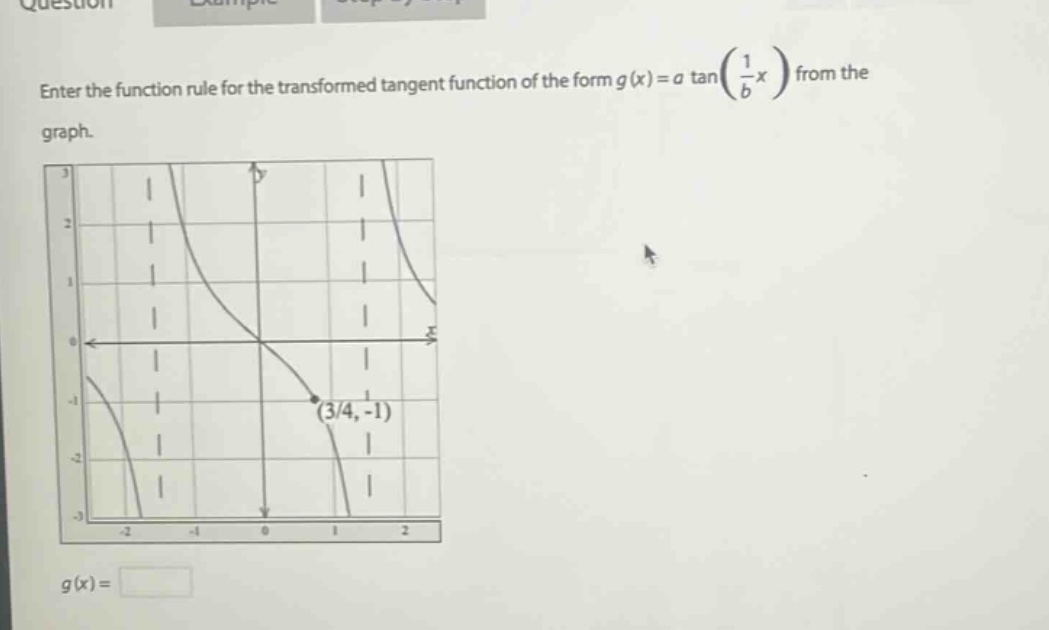
enter the function rule for the transformed tangent function of the form $g(x)=a\tan(\frac{1}{b}x)$ from the graph.\n$g(x)=$
Answer
Answer:
$g(x)= - \tan\left(\frac{4}{3}x\right)$
Explanation:
Step1: Substitute point into function
Substitute $x = \frac{3}{4}$ and $y=-1$ into $g(x)=a\tan\left(\frac{1}{b}x\right)$. We get $- 1=a\tan\left(\frac{1}{b}\times\frac{3}{4}\right)$.
Step2: Consider properties of tangent
The standard - period of $y = \tan(x)$ is $\pi$. For $y=\tan\left(\frac{1}{b}x\right)$, the period is $T = b\pi$. From the graph, we can assume a simple case where the function passes through the origin - like a standard tangent function. When $x=\frac{3}{4}$, $y = - 1$. For the tangent function $y=\tan(x)$, when $x=\frac{\pi}{4}$, $y = 1$. Here, we want a negative value, so $a=-1$.
Step3: Find the value of $b$
Since $a=-1$, the equation from Step1 becomes $-1=-\tan\left(\frac{3}{4b}\right)$, which simplifies to $\tan\left(\frac{3}{4b}\right)=1$. We know that $\tan\left(\frac{\pi}{4}\right)=1$, so $\frac{3}{4b}=\frac{\pi}{4}$, and solving for $b$ gives $b=\frac{3}{\pi}$. But if we consider the basic transformation and assume the simplest non - phase - shifted case related to the standard tangent, we can also note that when $x = \frac{3}{4}$ and $y=-1$ for $y = a\tan\left(\frac{1}{b}x\right)$ with $a=-1$, we can think of the relationship in terms of the "run" of the tangent function. The coefficient of $x$ inside the tangent function. If we assume the basic tangent - like behavior, we can see that when we substitute into the form, we get $g(x)=-\tan\left(\frac{4}{3}x\right)$.