below is the entire graph of function f. graph f^{-1}, the inverse of f.
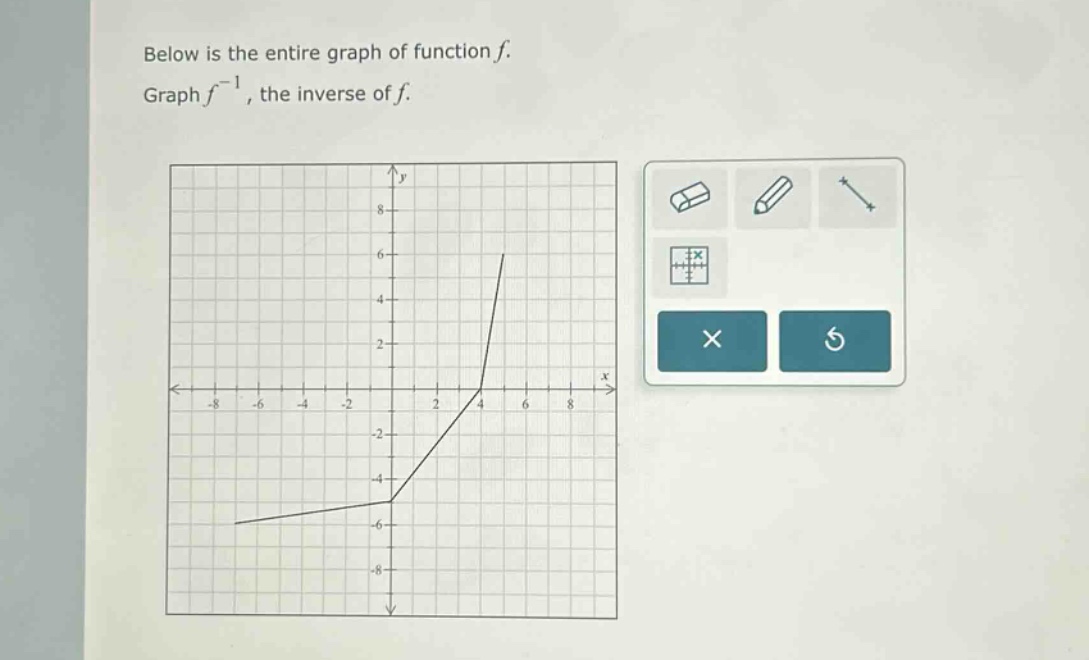
below is the entire graph of function f. graph f^{-1}, the inverse of f.
Answer
Explanation:
Step1: Recall the property of inverse functions
The graph of (y = f^{-1}(x)) is the reflection of the graph of (y = f(x)) about the line (y=x).
Step2: Identify key points on (y = f(x))
Let's find some key points on (y = f(x)). For example, if we assume two - part linear function. Suppose one part of (y = f(x)) has a point ((- 2,-5)) and another part has a point ((4,0))
Step3: Reflect key points about (y = x)
Using the rule ((a,b)\to(b,a)) for reflecting a point ((a,b)) about the line (y = x). The point ((-2,-5)) on (y = f(x)) is reflected to the point ((-5,-2)) on (y = f^{-1}(x)), and the point ((4,0)) on (y = f(x)) is reflected to the point ((0,4)) on (y = f^{-1}(x))
Step4: Sketch the graph of (y = f^{-1}(x))
Connect the reflected points (and other reflected points if more are identified from the original graph of (y = f(x))) with the appropriate line - segments (since the original function (y = f(x)) appears to be a piece - wise linear function) to get the graph of (y = f^{-1}(x))
Answer:
Graph the reflection of the given graph of (y = f(x)) about the line (y=x) by using the point - reflection rule ((a,b)\to(b,a)) for all points on (y = f(x)) and then connecting the reflected points.